| Lesson 5 | Modern Oracle Web Integration |
| Objective | Describe the Oracle Web Integration architecture and the modern replacements for legacy WRB Cartridges. |
Modern Oracle Web Integration
Oracle Web Request Broker (WRB) Cartridges were deprecated in Oracle WebLogic Server 12c Release 2 (12.2.1.4). Oracle will no longer provide support for WRB Cartridges beyond that release. Organizations still running WRB Cartridges should plan migration to modern alternatives as soon as possible to avoid future support risk.
WRB Cartridges extended Oracle WebServer and WebLogic Server functionality by providing integration with external systems and services. The cartridge model consisted of three components that are each superseded in Oracle 23ai:
- WRB Dispatcher: received requests from the web listener and routed them to the appropriate cartridge process. Replaced by the ORDS request routing engine and Oracle API Gateway.
- Executable Engines: persistent processes hosting the cartridge runtime — PL/SQL Agent, Java Cartridge, and LiveHTML Cartridge. Replaced by ORDS PL/SQL Gateway, WebLogic microservices, and APEX dynamic pages respectively.
- Cartridge instances: handled specific request types within the engine process. Replaced by ORDS REST API modules, OCI Functions, and Oracle Integration flows.
Web Request Broker and Cartridges
The Web Request Broker handled web requests for Oracle data by maintaining a pool of persistent cartridge processes — an improvement over the per-request CGI process spawning model it replaced. The WRB consisted of a dispatcher that received requests from the web listener, executable engines that hosted cartridge processes, and cartridge instances that handled specific content types.
Oracle published the WRB API so that third-party vendors could write additional cartridges for the Oracle Web Request Broker, extending the platform beyond Oracle's own PL/SQL, Java, and LiveHTML cartridges. That extensibility model is now superseded by standards-based REST APIs, ORDS modules, and OCI-native extension services that any vendor or developer can integrate with using industry-standard HTTP and JSON.
Modern Oracle 23ai Web Integration Architecture
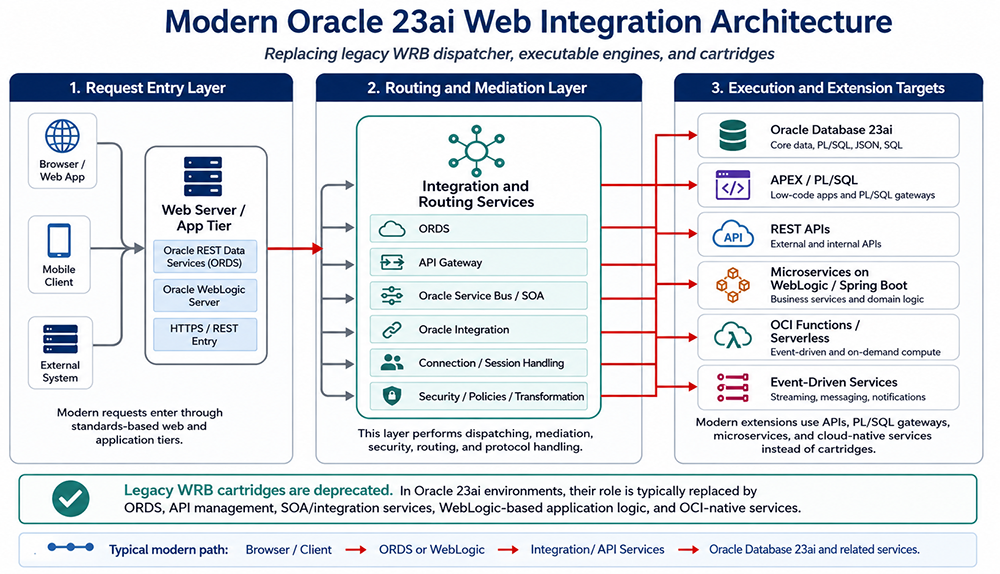
Layer 1 — Request Entry Layer
Modern Oracle 23ai web applications accept requests from three categories of clients:
- Browser/Web App: standard HTTPS requests from desktop or mobile browsers, Oracle APEX applications, and JavaScript-based single-page applications.
- Mobile Client: REST API calls from native iOS, Android, or cross-platform mobile applications consuming Oracle database services via ORDS endpoints.
- External System: system-to-system integration calls from external applications, ERP systems, partner services, or legacy systems using REST, SOAP, or messaging protocols.
All three client types enter through the Web Server/App Tier — either ORDS for database-direct REST, APEX, and PL/SQL access, or Oracle WebLogic Server for Java EE/Jakarta EE application logic. ORDS is the primary entry point for Oracle 23ai database-driven web requests.
Layer 2 — Routing and Mediation Layer
The Routing and Mediation Layer is the direct architectural successor to the WRB Dispatcher and Executable Engines. Instead of a monolithic broker with proprietary cartridge slots, Oracle 23ai uses a composable set of services:
Oracle REST Data Services (ORDS)
For database-direct routing — REST API modules, APEX page processing, and PL/SQL Gateway. ORDS handles connection pooling, session management, OAuth2 authentication, and response formatting. It is the primary routing layer for most Oracle 23ai web workloads and the mandatory web listener for Oracle APEX on Oracle 23ai.
Oracle API Gateway (OCI)
For full API lifecycle management — routing, rate limiting, policy enforcement, and analytics. API Gateway sits in front of ORDS or WebLogic and provides enterprise API management without custom coding. Appropriate for high-volume public APIs requiring throttling and usage tracking.
Oracle Service Bus (OSB) / Oracle SOA Suite
For on-premises or hybrid integration — service mediation, routing, protocol transformation, and reliable messaging. OSB is the established WRB successor for complex enterprise integration patterns requiring guaranteed delivery, orchestration, and on-premises control.
Oracle Integration (OIC)
For cloud-first integration — visual integration flows connecting Oracle and third-party SaaS applications, process automation, and AI-assisted integration. OIC replaces custom broker logic with declarative, low-code integration design suited to Oracle 23ai Autonomous Database deployments.
Connection / Session Handling and Security / Policies / Transformation
These cross-cutting concerns are handled natively by ORDS (JDBC connection pooling, OAuth2, sessionless transactions in Oracle 23ai) and by API Gateway or OSB (policy enforcement, protocol transformation, and threat protection).
Layer 3 — Execution and Extension Targets
Where legacy WRB Cartridges executed specific content types — PL/SQL via PL/SQL Agent, Java via Java Cartridge, HTML via LiveHTML Cartridge — Oracle 23ai provides a richer and more scalable set of execution targets:
- Oracle Database 23ai: the primary execution target for SQL, PL/SQL, JSON processing, and JSON Relational Duality View access. The database engine is unchanged from the WRB era; the path to reach it is modernized through ORDS and Oracle Net.
- APEX / PL/SQL Gateway: low-code APEX applications and PL/SQL-based web services. The direct successor to the PL/SQL Agent cartridge — the same database stored procedures, now accessed through a REST-native interface.
- REST APIs: external and internal REST endpoints. Modern applications consume and expose REST APIs natively rather than through proprietary cartridge protocols requiring custom SDK integration.
- Microservices on WebLogic / Spring Boot: business logic deployed as independent Java services, replacing monolithic cartridge-hosted application logic with independently deployable, independently scalable service units.
- OCI Functions / Serverless: event-driven, on-demand compute for lightweight extensions that do not require a persistent application server. Replaces the ad-hoc process spawning model of legacy CGI and eliminates the idle cartridge process overhead of the WRB era.
- Event-Driven Services: Oracle Streaming (Kafka-compatible), GoldenGate, and notification services for real-time integration patterns that synchronous cartridge-based brokers could not support — real-time change data capture, stream processing, and async notification delivery.
Migration Recommendations
Oracle's guidance for migrating from WRB Cartridges follows three paths based on deployment model:
Cloud-first: migrate to Oracle Integration Cloud (OIC) or OCI services — API Gateway combined with OCI Functions for serverless extensions. This path is appropriate for new Oracle 23ai Autonomous Database deployments where on-premises infrastructure is being reduced or eliminated.
On-premises / Hybrid: ORDS + WebLogic + SOA Suite is the established migration path. PL/SQL Cartridge logic migrates to ORDS PL/SQL Gateway; Java Cartridge logic migrates to WebLogic-hosted microservices or Spring Boot; LiveHTML logic migrates to APEX dynamic pages. This path preserves existing Java and PL/SQL investments while eliminating deprecated components.
Modern applications: use REST/JSON with ORDS or direct WebLogic microservices with Jakarta EE or MicroProfile. Oracle recommends moving away from all deprecated components to avoid future support gaps. Refer to the latest WebLogic release notes and Oracle Fusion Middleware deprecation lists for version-specific guidance.
The typical modern request path — Browser/Client → ORDS or WebLogic → Integration/API Services → Oracle Database 23ai — is simpler, more scalable, and more maintainable than the legacy WRB Cartridge architecture it replaces. The next lesson examines web-based tuning tips for Oracle web applications — practical DBA-level optimizations that apply to the modern ORDS and Oracle 23ai web tier.