| Lesson 5 | Oracle Unified Directory |
| Objective | Explain OUD's LDAP role and distinguish directory services, application identity, API authorization, database authentication, and content storage in Oracle 26ai architectures. |
Oracle Unified Directory and Modern Application Identity
Oracle Unified Directory (OUD) manages directory entries and LDAP access. Identity services handle application sign-in and token issuance. Oracle REST Data Services (ORDS) exposes configured application APIs, while database tables, LOBs, and object storage hold application content. These components can work together in an Oracle AI Database 26ai architecture, but they serve different purposes.
For a database administrator, the essential questions are where identities are maintained, how an application authenticates its users, which operations it permits, and how it connects to the database. Choosing a newer database release does not answer those questions automatically.
What Oracle Unified Directory Does
OUD is a Java-based, LDAPv3-compliant directory service. Its directory-server mode stores entries representing users, groups, and identity attributes. Applications can use LDAP operations to look up those entries and, under the configured security rules, authenticate or update directory information.
Its proxy functionality routes LDAP requests to configured directory backends. A proxy does not itself become the authoritative identity store. Replication distributes changes between directory-server instances and supports availability, but administrators still need to design failover, monitor replication, and account for outages or delayed updates.
Synchronization and virtualization can support integrations with other identity sources. They require deliberate configuration and applicable product capabilities; they do not automatically combine every corporate directory into one consistent identity model.
Select OUD according to application requirements, directory schemas, supported integrations, and operational needs. A directory deployment also requires access controls, protected LDAP connections, account management, and monitoring. Storing a group membership does not, by itself, assign that group a database privilege or an application role.
OUD, OID, and Oracle Middleware
OUD and Oracle Internet Directory (OID) are separate products. OID uses an Oracle Database repository. Oracle publishes documentation for both; OUD should not be described as having universally replaced OID. Their product versions and configuration requirements are separate from the Oracle AI Database 26ai release.
OUD can be configured as a user identity store for Oracle Access Manager (OAM), which also supports other identity stores. OAM's policy data belongs in its database repository, not automatically in OUD. Similarly, WebLogic's embedded LDAP store and an external LDAP authentication provider are distinct configurations.
Here, a directory means a structured information service. It is not a website folder, a media file server, the historical Oracle Internet File System, or a SQL DIRECTORY object that names a server-side filesystem location.
Separate the Responsibilities
| Responsibility | Typical component | Important distinction |
|---|---|---|
| LDAP identity directory | OUD, OID, or another supported directory | Directory entries are not a media repository or a REST API. |
| Application sign-in and federation | OCI IAM identity domains or another identity provider | Successful sign-in does not grant access to every API or database. |
| API exposure and authorization | ORDS or an application service | Resources and access rules must be configured explicitly. |
| Database authentication and privileges | Configured Oracle database security | The database session need not represent the browser user's identity directly. |
| Content and metadata storage | Tables, SecureFiles BLOBs, JSON, or object storage | Content storage does not replace directory or identity services. |
Oracle Net directory naming is another distinct responsibility: it resolves a connect identifier to a connect descriptor containing database connection information. Resolving where to connect is separate from authenticating the database user, even when directory infrastructure participates in both tasks.
Modern Connectivity, Content, and Identity
The following diagram places identity alongside the application's data and content functions. It is an application overview rather than an OUD deployment diagram. OUD is not shown; it may participate through a separately configured directory integration where required.
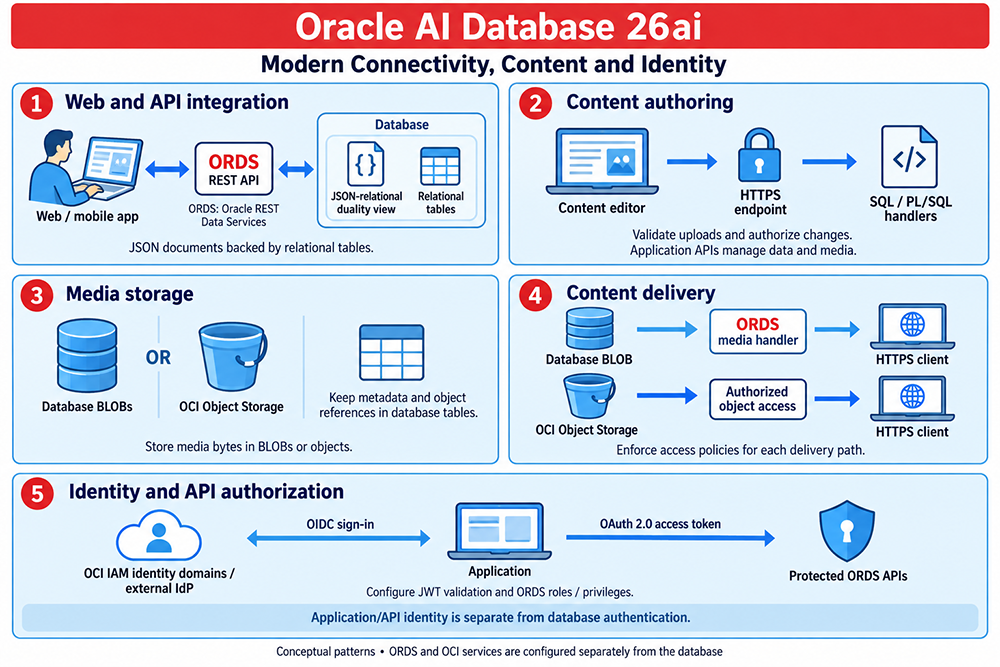
- Web and API integration: ORDS handles configured HTTP endpoints backed by SQL, PL/SQL, and database data. JSON-relational duality views present relational data as JSON documents. They model application data rather than supplying directory services or user authentication.
- Content authoring: The application receives updates over HTTPS, validates uploads, and authorizes changes before invoking the appropriate handlers. HTTPS protects transport; permission to change a document or image still requires application rules.
- Media storage: Applications store media bytes in database BLOBs or object storage and retain metadata or object references in tables. Each design needs appropriate access controls and lifecycle management.
- Content delivery: A configured ORDS media handler can serve database content. Object storage has a separate authorized access path. Protect both paths rather than assuming that access to one implies access to the other.
- Identity and API authorization: An identity provider supports application sign-in, and the application presents an appropriate access token to protected APIs. For the JWT-based pattern shown, configure trusted issuers, audience, signature and lifetime checks, and the required ORDS authorization mappings.
OCI IAM Identity Domains and Token-Based Access
OCI IAM identity domains provide application identity capabilities, including federation and support for OpenID Connect and OAuth 2.0. Oracle incorporated Identity Cloud Service (IDCS) capabilities into OCI IAM, so identity domains are the appropriate terminology for this discussion.
OpenID Connect (OIDC) supports user authentication and sign-in. OAuth 2.0 provides an authorization framework for obtaining and using access tokens. An OIDC ID token is not automatically an API access token. A JSON Web Token (JWT) is a token format, and not every OAuth access token must use that format.
For a protected ORDS API, accepting a trusted token and authorizing an operation are related but separate checks. Configure the supported token-validation and role or privilege mapping for the deployed ORDS version. A token accepted by ORDS does not automatically authenticate a database session or grant SQL privileges.
When OUD Fits the Architecture
Consider an enterprise application that requires LDAP user and group lookups and already has a supported directory integration. OUD can provide that directory role. Introducing a web sign-in service does not necessarily remove the underlying LDAP requirement.
For a web or mobile application needing federated sign-in and protected HTTP APIs, OCI IAM identity domains or another identity provider can supply the sign-in and token services. Existing directories may remain part of the wider identity architecture, while the application and APIs enforce their own access rules.
An upgrade to Oracle 26ai alone does not require an OUD-to-IAM migration. Assess the protocols applications need, the authoritative source of identities, supported integrations, and operational responsibilities. Keep directory access, API authorization, database privileges, and content delivery explicit in the design.
Oracle References
- Introduction to Oracle Unified Directory and Oracle Internet Directory documentation
- OUD as an OAM identity store and OAM policy and session database
- OCI IAM identity-domain technologies
- Protecting ORDS resources with OCI IAM-issued JWTs
- Oracle 26ai network naming methods
Oracle Catalog Architecture - Exercise
Oracle Oracle Catalog Architecture - Exercise
The next lesson describes some of the other tools and technologies Oracle offers.