| Lesson 7 | Oracle WebLogic Server and OCI Integration |
| Objective | Describe the role of Oracle WebLogic Server as the core component of Oracle Fusion Middleware and explain how it integrates with Oracle 23ai on Oracle Cloud Infrastructure. |
Oracle WebLogic Server and Modern Middleware Integration
Oracle WebLogic Server is the enterprise-grade Java application server at the core of Oracle Fusion Middleware. It provides the runtime environment for deploying Java EE and Jakarta EE applications, including modernized Oracle Forms and Reports, and serves as the foundation on which Oracle middleware products — including Oracle SOA Suite, Oracle Service Bus, and Oracle WebCenter — are built and executed. Current versions include WebLogic Server 14.1.2 and 15.1.1, both certified with Oracle Database 23ai and bundled with the latest Oracle JDBC 23ai drivers.
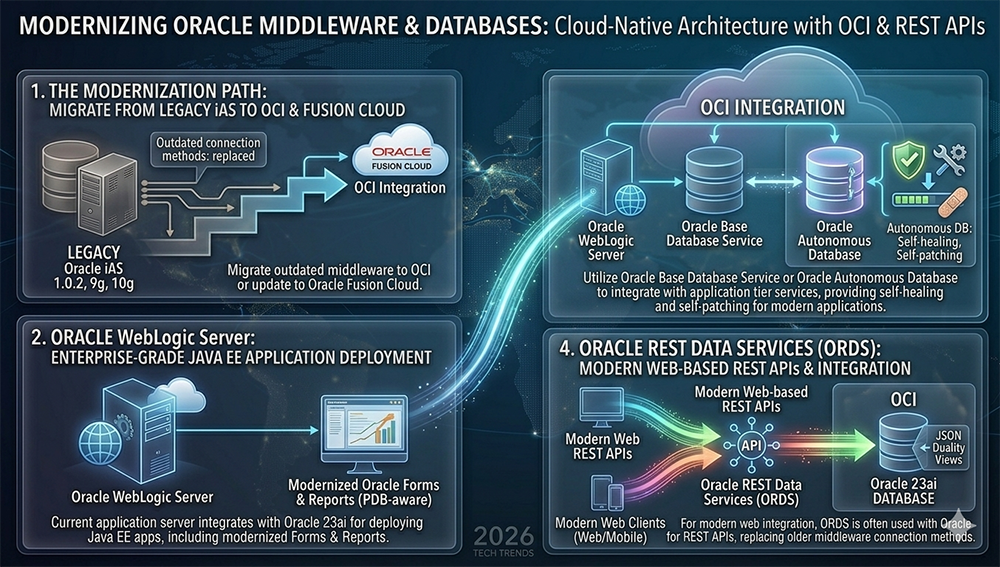
1. The Modernization Path
Legacy Oracle Internet Application Server versions — including iAS 1.0.2, 9g, and 10g — are outdated middleware products that ran on unsupported server environments and are no longer viable for production deployments. Modernization involves migrating these environments to current Oracle Fusion Middleware versions running on Oracle Cloud Infrastructure, or moving to Oracle Fusion Cloud Applications where full SaaS eliminates the need to manage middleware infrastructure entirely.
The typical migration path moves from legacy iAS through current Fusion Middleware releases — specifically FMW 12.2.1.4 or WebLogic 14.1.2 — either as lift-and-shift deployments on OCI Compute or as containerized workloads on Oracle Kubernetes Engine. This progression reduces maintenance overhead, resolves security and compliance risks associated with unsupported systems, and unlocks access to Oracle 23ai capabilities including AI Vector Search, JSON Relational Duality Views, and native Boolean datatype support.
2. Oracle WebLogic Server
WebLogic Server handles Java application deployment and execution, clustering and high availability, transaction management, security and identity integration, and resource pooling through JDBC and JMS connection management. The WebLogic Admin Console and Fusion Middleware Control provide centralized management and monitoring across WebLogic domains.
For organizations running Oracle Forms, WebLogic Server 14.1.2 supports Oracle Forms 14.1.2 in a modern Java environment while providing full access to Oracle 23ai features through the latest JDBC drivers. This allows legacy Forms applications to continue operating while the underlying database tier is modernized, deferring application-layer rewrites until the infrastructure migration is stable.
3. OCI Integration
Within Oracle Cloud Infrastructure, WebLogic Server integrates with Oracle Base Database Service for deployments requiring full administrative control, RAC, or Exadata capabilities, and with Oracle Autonomous Database for self-healing, self-patching environments that reduce operational overhead. Oracle WebLogic Server for OCI simplifies provisioning, scaling, and domain management, with automated patching, high availability configuration, and native integration with OCI IAM for identity and access control.
Containerized WebLogic deployments on Oracle Kubernetes Engine extend this further, providing horizontal scaling and operational consistency across cloud-native and traditional application workloads. For new deployments on OCI, the combination of WebLogic Server with Autonomous Database 23ai represents the recommended architecture for Java EE applications requiring enterprise transaction management and database integration.
4. Oracle REST Data Services (ORDS)
Oracle REST Data Services complements WebLogic Server deployments by providing standards-based HTTP and HTTPS access to Oracle 23ai data. ORDS can run standalone, within Autonomous Database, or as a web application deployed on WebLogic Server itself, depending on the architectural requirements of the deployment.
For internet-facing applications, ORDS replaces older proprietary middleware connection methods — including direct Forms-to-database connections and custom servlet integrations — with RESTful API endpoints that web, mobile, and microservices clients can consume directly. Combined with JSON Relational Duality Views in Oracle 23ai, ORDS allows developers to work with relational data using JSON document patterns, maintaining enterprise-grade transactions and security while reducing the complexity of the integration layer between the database and the application tier.
Java Web - Exercise
Java Web - Exercise
The next lesson gives you an overview of other Internet-related tools Oracle offers.