| Lesson 6 | How to obtain archive log information |
| Objective | Retrieve archive log information in Oracle 23ai |
How to Obtain Archive Log Information
- Source: V$ARCHIVED_LOG reads from the control file
- Record creation timing: Records are inserted after successful archiving or clearing operations
- NULL names: The NAME column is indeed NULL when a log is cleared rather than archived
- Multiple archives: Archiving the same sequence number to multiple destinations creates multiple records with identical THREAD#, SEQUENCE#, and FIRST_CHANGE# but different NAME values
- RMAN operations: Records are also created during RESTORE operations and when using RMAN COPY commands
This will display as a clean numbered list when rendered in a browser or HTML context. V$ARCHIVED_LOG is particularly useful for monitoring archiving operations and identifying gaps in the archive log sequence, which is often why DBAs query this view. But what you have is accurate as written.
In Oracle Database 23ai, it is still important to retrieve and monitor archive log information for most real-world environments. ARCHIVELOG mode is foundational for point-in-time recovery (PITR), Data Guard, and typical online backup strategies. Even when you use Flashback features, archived redo remains part of the broader recovery and availability story.
Is retrieving archive log information still necessary in Oracle 23ai?
Yes. The core ARCHIVELOG behavior remains consistent in 23ai: if you care about recovery, HA/DR, or operational correctness, you still need visibility into redo generation and archiving.
| Feature / requirement | Requires ARCHIVELOG mode? | Changed in 23ai? | Notes |
|---|---|---|---|
| Point-in-time recovery (PITR) | Yes | No | Classic recovery still depends on archived redo. |
| Data Guard (physical standby) | Yes | No | Redo transport/apply depends on archived redo (and/or real-time redo). |
| Online backups and incremental backups | Yes (strongly recommended) | No | NOARCHIVELOG usually implies cold backups only. |
| Restore points / Flashback beyond short retention windows | Yes | No | Flashback logs help, but archived redo remains central for many recovery workflows. |
What did improve in 23ai is flashback log placement flexibility: Oracle introduced parameters that let you separate Flashback logs from the FRA, reducing I/O contention. That is helpful, but it does not remove the need for archived redo.
DB_FLASHBACK_LOG_DESTDB_FLASHBACK_LOG_DEST_SIZE
Fastest single summary: ARCHIVE LOG LIST in SQL*Plus (or SQLcl)
The simplest “at-a-glance” command is ARCHIVE LOG LIST. It shows whether you are in ARCHIVELOG mode, whether automatic archiving is enabled, the active archive destination, and key sequence numbers.
-
Connect with SYSDBA privileges:
sqlplus / as sysdba -
Run the command:
ARCHIVE LOG LIST;
Example output (typical format)
Database log mode              Archive Mode
Automatic archival             Enabled
Archive destination            /u01/app/oracle/fast_recovery_area/ORCL/archivelog
Oldest online log sequence     100
Next log sequence to archive   102
Current log sequence           102
The most important takeaways are:
- Database log mode: confirms ARCHIVELOG vs NOARCHIVELOG.
- Automatic archival: whether archiving is actively running.
- Archive destination: where archived redo is currently going (often FRA-based).
- Sequence fields: quick sense of redo progress and whether archiving is keeping up.
Understand the ARCHIVE LOG LIST fields
| ARCHIVE LOG LIST entry | Description |
|---|---|
| Database log mode | ARCHIVELOG or NOARCHIVELOG mode (from control file state). |
| Automatic archival | Whether automatic archiving is enabled and functioning. |
| Archive destination | Active destination used for archived redo (often aligned with LOG_ARCHIVE_DEST_n or FRA). |
| Oldest online log sequence | The sequence number of the oldest online redo log still in the online log set. |
| Next log sequence to archive | The next sequence expected to be archived. |
| Current log sequence | The sequence currently being written (or most recently current). |
Query dynamic performance views for deeper detail
For operational monitoring (and for troubleshooting “archive destination full”, “cannot archive”, or Data Guard gaps), you typically query dynamic performance views. These are often more actionable than ARCHIVE LOG LIST alone.
Confirm log mode quickly
SELECT log_mode
FROM v$database;
Archive destinations and status
SELECT dest_id, status, destination, target, valid_now, error
FROM v$archive_dest
ORDER BY dest_id;
If you are diagnosing transport/apply issues (especially with Data Guard), V$ARCHIVE_DEST_STATUS is commonly used as well.
Archived log history recorded in the control file
SELECT thread#, sequence#, first_time, next_time, applied, name
FROM v$archived_log
ORDER BY thread#, sequence#;
Log switches captured in the control file
SELECT thread#, sequence#, first_time
FROM v$log_history
ORDER BY thread#, sequence#;
Rule of thumb: use V$ARCHIVED_LOG when you care about archived redo files (including names and applied status),
and use V$LOG_HISTORY when you care about log switch history as recorded in the control file.
The diagrams below summarize three commonly referenced views for archived redo visibility and archiving state.
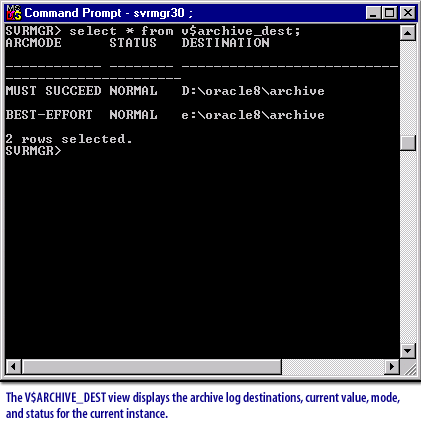
V$ARCHIVE_DEST summarizes archive destinations and their current value, mode, status, and errors for the instance.
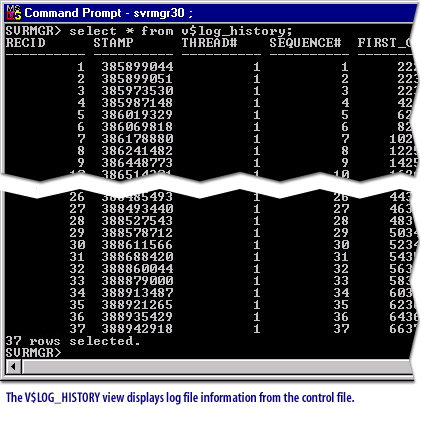
V$LOG_HISTORY shows log switch history recorded in the control file (sequence numbers and timestamps).
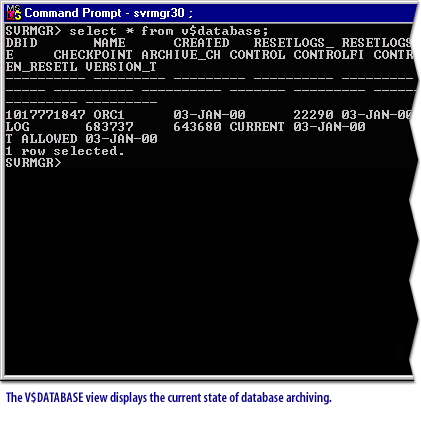
V$DATABASE reports database-wide properties including LOG_MODE (ARCHIVELOG / NOARCHIVELOG).
The next lesson introduces standby databases, where archived redo visibility becomes even more important for transport, apply, and gap detection.