| Lesson 5 | The WITH ADMIN OPTION Clause |
| Objective | Allow other users to manage system privileges. |
The WITH ADMIN OPTION Clause in Oracle AI Database 26ai
WITH ADMIN OPTION is one of the oldest privilege-delegation mechanisms in Oracle, well
established by the time of Oracle 8i and likely older still; a delegation feature this
fundamental tends to predate most of what a course like this one needs to cover as
version-specific. Its actual behavior remains exactly what it has always been: a user who
receives a privilege WITH ADMIN OPTION can, in turn, grant that same privilege to others.
System privileges are usually granted by a DBA, but the DBA isn't the only person who
can do it. Anyone holding a specific privilege WITH ADMIN OPTION can grant that one
privilege onward, and anyone holding GRANT ANY PRIVILEGE can grant nearly any system
privilege at all. Trusting a specific user with one of these paths, rather than routing
every grant through the DBA personally, is exactly what this lesson covers.
Granting a Specific Privilege WITH ADMIN OPTION
To grant a privilege and let the recipient further grant that same privilege to others,
add WITH ADMIN OPTION to the end of the GRANT command:
GRANT CREATE USER, CREATE SESSION TO jeff WITH ADMIN OPTION;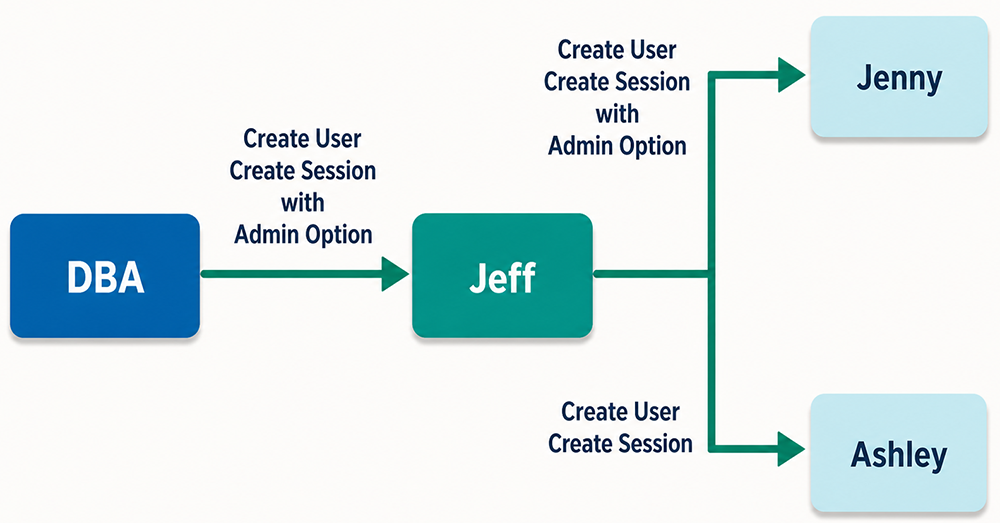
- The DBA grants CREATE SESSION and CREATE USER to Jeff, including WITH ADMIN OPTION. Jeff may now grant those privileges to other users.
- Jeff grants the same two privileges to Jenny, including the admin option. Jenny may now grant those privileges to other users in turn.
- Jeff separately grants the same two privileges to Ashley, but without the admin option. Ashley receives the privileges herself but cannot pass them on to anyone else.
One behavior worth understanding precisely, since it comes up constantly once privileges
start flowing through more than one person: a privilege granted through the admin option
stays with the recipient even if it is later revoked from whoever did the granting.
Looking at the diagram above, revoking CREATE SESSION from Jeff would not affect Jenny or
Ashley at all; each of their grants exists independently once made; the DBA would need to
revoke from Jenny and Ashley separately to remove it from them too.
Format for the GRANT Command
The general form of GRANT for system privileges and roles:
GRANT {system_privilege | role}
[, {system_privilege | role}, ...]
TO {user | role} [, {user | role}] ...
[WITH ADMIN OPTION];Granting the Ability to Manage Any System Privilege
WITH ADMIN OPTION on a single privilege only lets the recipient manage that one
privilege. For someone who genuinely needs broader delegation authority, GRANT ANY
PRIVILEGE grants the ability to grant or revoke nearly any system privilege at all,
including granting to roles:
GRANT GRANT ANY PRIVILEGE TO security_admin;GRANT CREATE SESSION, CREATE VIEW TO app_user;
REVOKE ALTER USER FROM app_user;GRANT GRANT ANY PRIVILEGE TO security_admin WITH ADMIN OPTION;A Common Pattern: A Role for Security Administrators
Rather than granting several delegation-related privileges to each security administrator
individually, bundling them into a dedicated role is usually cleaner:
CREATE ROLE privilege_admin;

GRANT GRANT ANY PRIVILEGE TO privilege_admin;
GRANT GRANT ANY ROLE TO privilege_admin;
GRANT CREATE USER, ALTER USER, DROP USER TO privilege_admin WITH ADMIN OPTION;

GRANT privilege_admin TO security_admin;Delegating Schema-Level Privilege Grants
Schema-level privileges, covered earlier in this module, have their own delegation path,
distinct from ordinary system privileges. To let someone grant schema-level privileges on
a schema they do not themselves own, they need GRANT ANY SCHEMA PRIVILEGE, the full,
three-word privilege name, or the broader GRANT ANY PRIVILEGE:
GRANT GRANT ANY SCHEMA PRIVILEGE TO security_admin;GRANT SELECT ANY TABLE ON SCHEMA hr TO
bob;, a schema privilege, not a classic system privilege, even though the syntax
looks related.
Checking Who Can Manage What
Query the data dictionary directly to see who currently holds delegation authority,
rather than relying on memory of who was granted what and when:
SELECT grantee, privilege, admin_option
FROM   dba_sys_privs
WHERE  privilege IN ('GRANT ANY PRIVILEGE', 'GRANT ANY SCHEMA PRIVILEGE', 'GRANT ANY ROLE')
ORDER BY grantee, privilege;