| Lesson 6 | Updating with a subquery |
| Objective | Write SQL to execute an Update using a Subquery in Oracle 23ai |
Write SQL to Update an Object Table Using a Subquery
When an object table contains a REF column — a typed pointer to a row in
another object table — the UPDATE statement cannot assign a new reference
value as a scalar literal. The reference must be retrieved at update time using a
subquery that calls the REF() function against the referenced object table.
This lesson covers the syntax, two worked examples, the runtime constraints that govern
subquery-based updates, and the broader context of updating REF columns
within Oracle's object-relational model.
Why a Subquery Is Required for REF Columns
A REF column stores an Oracle object identifier — an internal pointer that
locates a specific row in a specific object table. This identifier is generated by Oracle
and is not a value you can write as a literal. The only way to obtain a valid reference
value in SQL is through the REF() function, which accepts a table alias and
returns the object reference for the row currently in scope under that alias. Because
REF() requires a table context, the assignment in the SET
clause must be a subquery rather than a direct value.
Within PRODUCT_OBJ_TABLE, the PACKAGE_ID column is a
REF that references the PRODUCT_TYPE object type. To update
this column, a subquery must retrieve the reference for the target product from the same
table before assigning it:
UPDATE product_obj_table p1
SET    p1.package_id = (SELECT REF(p2)
                        FROM   product_obj_table p2
                        WHERE  p2.product_id = 14)
WHERE  p1.product_id = 22;
This statement updates the package_id reference on row 22 to point to row
14 in the same table. Both the outer and inner queries target
product_obj_table but use distinct aliases — p1 for the row
being updated and p2 for the row being referenced — to prevent Oracle from
conflating the two table instances.
Syntax Template — UPDATE with REF Subquery
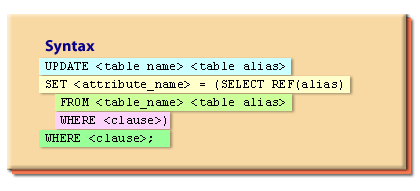
UPDATE <table_name> <table_alias>
SET <attribute_name> = (SELECT REF(alias)
                        FROM <table_name> <table_alias>
                        WHERE <clause>)
WHERE <clause>;| Location 1 | The UPDATE clause naming the target object table and
declaring the required alias |
| Location 2 | The SET clause assigning the REF column to the result
of the subquery |
| Location 3 | The FROM clause of the subquery, naming the referenced object table
with a distinct alias |
| Location 4 | The WHERE clause of the subquery, filtering on a primary key or
unique column to guarantee exactly one reference is returned |
| Location 5 | The outer WHERE clause identifying which row in the target table
receives the updated reference |
Two Runtime Constraints
Two constraints govern the correctness of this pattern at runtime:
- The subquery must return exactly one row. If the inner
WHEREclause matches multiple rows, Oracle raisesORA-01427: single-row subquery returns more than one row. Always filter the subquery on a primary key or unique column to guarantee a single reference is returned. In the example above,p2.product_id = 14filters on the primary key — one row, one reference. - The outer and inner aliases must be distinct. Both queries target
the same table in a self-referential update. Using the same alias for both would cause
Oracle to resolve the inner alias against the outer table context, producing incorrect
results or an error.
p1andp2are distinct and unambiguous throughout the statement.
Worked Example
UPDATE product_obj_table p1
SET    p1.package_id = (SELECT REF(p2)
                        FROM   product_obj_table p2
                        WHERE  p2.product_id = 14)
WHERE  p1.product_id = 22;
UPDATE product_obj_table p1— targets the row being modified, aliased asp1SET p1.package_id =— theREFcolumn receives the result of the subquery; alias prefix follows Oracle 23ai object table best practiceSELECT REF(p2) FROM product_obj_table p2— retrieves the object reference for the source row using a distinct aliasp2WHERE p2.product_id = 14— filters the subquery to the specific row whose reference is being assignedWHERE p1.product_id = 22— identifies the row in the outer table whosepackage_idis being updated
Second Syntax Template — Updating a REF from a Different Table
The same pattern applies when the subquery targets a different object table from the
one being updated. This is the more common case — a child table holds a
REF to a parent table, and the reference needs to be reassigned:
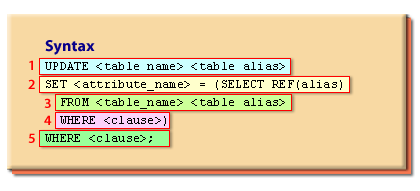
UPDATE <table_name> <table_alias>
SET <attribute_name> = (SELECT REF(alias)
                        FROM <table_name> <table_alias>
                        WHERE <clause>)
WHERE <clause>;| Location 1 | The UPDATE statement specifying the target
object table and its alias |
|---|---|
| Locations 2–4 | The subquery using REF(alias) to retrieve the object reference
from the referenced table, with its own alias and WHERE filter |
| Location 5 | The outer WHERE clause identifying which row receives the
updated reference value |
Updating a REF to a Different Object Table
In the pet store schema, PET_CARE_LOG_OBJ_TABLE contains a
product_ref column that references PRODUCT_OBJ_TABLE. To
reassign a log entry to a different product, the subquery retrieves the reference from
PRODUCT_OBJ_TABLE and assigns it to the REF column in
PET_CARE_LOG_OBJ_TABLE:
UPDATE pet_care_log_obj_table pcl
SET    pcl.product_ref = (SELECT REF(p)
                          FROM   product_obj_table p
                          WHERE  p.product_id = 34)
WHERE  pcl.log_id = 7;
The outer and inner tables are different here — pcl aliases the log table
being updated, and p aliases the product table being referenced. The
single-row constraint still applies: p.product_id = 34 must match exactly
one row in PRODUCT_OBJ_TABLE.
Dangling References After UPDATE
When a REF column is updated to point to a new object, the old reference
is simply replaced — Oracle does not cascade any changes to the previously referenced
object. If the previously referenced object is later dropped using
DROP USER CASCADE or a direct DELETE, any
REF columns that still point to it become dangling references. A dangling
reference is one that points to an object that no longer exists.
Dangling references can be detected with the IS DANGLING predicate and
should be handled before any application code attempts to dereference them:
-- Identify dangling references in pet_care_log_obj_table
SELECT pcl.log_id
FROM   pet_care_log_obj_table pcl
WHERE  pcl.product_ref IS DANGLING;
In Oracle 23ai, referential integrity for REF columns can be enforced
using the REFERENCES constraint on the REF column definition,
which prevents the referenced object from being deleted while references to it exist —
analogous to a foreign key constraint on a relational table.
Comparing Subquery UPDATE to Direct UPDATE
The distinction between a direct attribute update and a subquery-based
REF update is worth summarizing explicitly:
-- Direct attribute update — no subquery needed
UPDATE customer_obj_table cot
SET    cot.full_address.zip = '09982'
WHERE  cot.cust_id = 1;

-- REF column update — subquery required
UPDATE pet_care_log_obj_table pcl
SET    pcl.product_ref = (SELECT REF(p)
                          FROM   product_obj_table p
                          WHERE  p.product_id = 34)
WHERE  pcl.log_id = 7;
The first form uses dot notation to navigate into a nested object type attribute — no
subquery is involved. The second form assigns a REF value that must be
obtained through REF() — a subquery is mandatory. The choice between
these two forms is determined entirely by the column type being updated, not by
developer preference.
Summary
Updating a REF column in an Oracle object table requires a subquery that
calls REF(alias) against the referenced object table. The subquery must
return exactly one row — filter on a primary key or unique column to guarantee this.
The outer and inner table aliases must be distinct, even when both queries target the
same table. Alias-prefix all column references in both the SET and
WHERE clauses for clarity and to follow Oracle 23ai object table best
practice. After updating a REF column, check for dangling references
using the IS DANGLING predicate if the previously referenced object may
have been removed. The next lesson covers writing DML statements to delete records
from object tables.