| Lesson 4 | SQL Server Services |
| Objective | Describe the Services available in Microsoft SQL Server 2025 |
Services Available in Microsoft SQL Server 2025
Microsoft SQL Server 2025 delivers its functionality through a set of background services — autonomous processes that run under Windows Server or Linux and provide the core capabilities of the platform. Each service operates under a security context: a Windows or domain account whose permissions determine which system resources the service can access. Understanding which services are available, what each one does, and how to manage their running state is foundational knowledge for anyone administering or developing against SQL Server 2025.
The primary installable services in SQL Server 2025 are the Database Engine, SQL Server Agent, and SQL Server Integration Services. Additional services — Analysis Services, Reporting Services, and the SQL Server Browser — support specific workloads and connectivity scenarios. This lesson covers all of them, with particular focus on the three most important for database creation and administration work.
Service States — Running, Paused, and Stopped
Every SQL Server service can be in one of three states at any given time:
- Running — the service is fully operational and providing the functionality it was designed for. Client connections are accepted, queries are processed, and scheduled jobs execute normally.
- Paused — existing connections and active transactions can complete, but no new connections are accepted. Pausing the Database Engine service allows a DBA to drain active sessions before performing maintenance without abruptly terminating in-flight transactions.
- Stopped — the service is not running and provides no functionality. A stopped Database Engine service means SQL Server will not respond to any queries or connection requests until the service is restarted.
Service state management is performed through SQL Server Configuration Manager, Windows Services
(services.msc), PowerShell, or the command prompt. SQL Server Configuration Manager
is the recommended tool because it understands SQL Server service dependencies and handles
startup account validation correctly.
1. SQL Server Database Engine — The Foundation Service
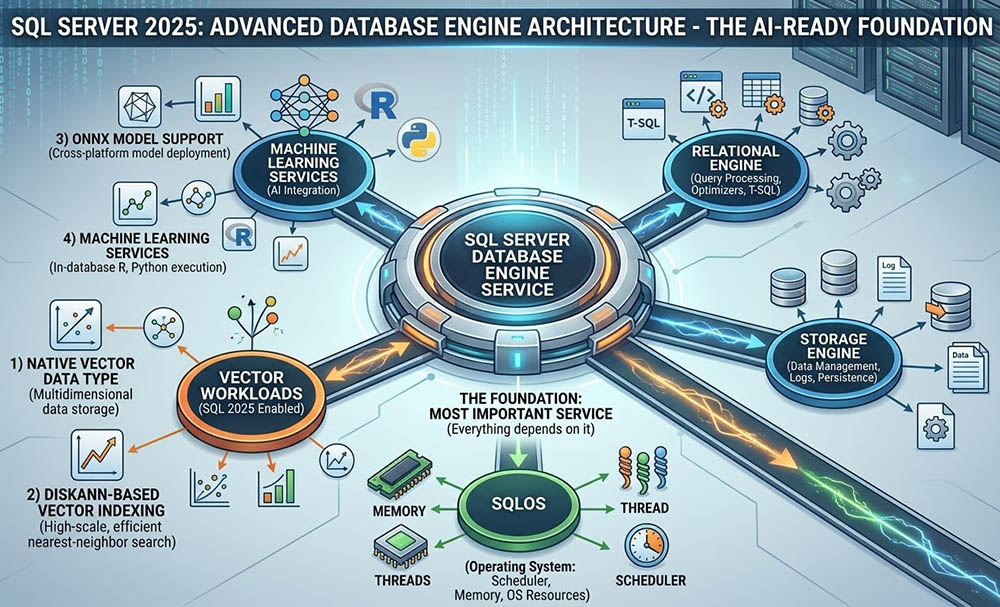
The Database Engine is the core SQL Server service and the foundation that every other service depends on. It is responsible for storing, processing, querying, and securing all data managed by SQL Server 2025. When the Database Engine service is stopped, SQL Server is effectively offline — no queries execute, no connections succeed, and no other SQL Server services can perform data operations.
The Database Engine in SQL Server 2025 is composed of five major subsystems:
- Relational Engine: Parses T-SQL statements, generates and optimizes execution plans through the query optimizer, and coordinates query execution. In SQL Server 2025 the Relational Engine incorporates the full Intelligent Query Processing (IQP) framework — adaptive joins, batch mode on row store, parameter sensitivity plan optimization, and degree of parallelism feedback — that continuously improves plan quality based on observed runtime behavior.
- Storage Engine: Manages all data access to the buffer pool and disk. It handles
page reads and writes, transaction log management, locking and isolation level enforcement, and
both row-store and column-store index structures. The Storage Engine in SQL Server 2025 also manages
the new native
VECTORdata type and its associated DiskANN-based approximate nearest neighbor indexes for vector similarity search. - SQLOS (SQL Server Operating System): A user-mode scheduling layer that manages CPU scheduling, memory allocation, I/O coordination, and synchronization primitives for all SQL Server processes. SQLOS provides consistent resource management across Windows Server, Linux, and container deployments.
- Vector Workloads: Native support for the
VECTORdata type,VECTOR_DISTANCEfunction, and DiskANN-based vector indexing introduced in SQL Server 2025. These capabilities enable AI and LLM workloads — including Retrieval-Augmented Generation (RAG) pipelines — to store and query high-dimensional embeddings directly within SQL Server without requiring a separate vector database. - Machine Learning Services: Enables in-database execution of Python, R, and Java
scripts alongside T-SQL. In SQL Server 2025, Machine Learning Services adds ONNX model support —
allowing trained machine learning models to be imported and scored directly within the Database
Engine using the
PREDICTfunction, without moving data to an external ML platform.
The Windows service name for the Database Engine is MSSQLSERVER for the default
instance, or MSSQL$instancename for named instances. On Linux, it runs as the
mssql-server systemd service.
2. SQL Server Agent — The Scheduling Service
SQL Server Agent is the job scheduling and automation service for SQL Server 2025. It runs as a
separate Windows service (SQLSERVERAGENT for the default instance) and depends on
the Database Engine service being in a Running state — if the Database Engine stops, SQL Server
Agent stops automatically.
SQL Server Agent handles all scheduled automation within SQL Server:
- Jobs — sequences of one or more job steps that execute T-SQL scripts, SSIS packages, PowerShell scripts, or operating system commands on a defined schedule or in response to an alert. Database backups, index rebuilds, statistics updates, and data import routines are all typically implemented as SQL Server Agent jobs.
- Schedules — define when jobs run: once, recurring on a time interval, at SQL Server startup, or when the CPU becomes idle. Multiple schedules can be attached to a single job.
- Alerts — monitor SQL Server error conditions, performance counter thresholds, and WMI events. When an alert condition is met, Agent can send an email notification through Database Mail, execute a job, or both.
- Operators — named recipients for alert notifications, defined by email address, pager address, or net send destination.
SQL Server Agent is not available in SQL Server 2025 Express edition — this is one of the primary reasons organizations move from Express to Standard or Enterprise when they need automated maintenance and scheduling capabilities.
3. SQL Server Integration Services (SSIS)
SQL Server Integration Services is the ETL (Extract, Transform, Load) platform that moves data into, out of, and between SQL Server instances and external data sources. SSIS is installed as a separate service and does not depend on the Database Engine being on the same machine — SSIS packages can connect to remote SQL Server instances, Azure SQL, Oracle, flat files, Excel, REST APIs, and any ODBC or OLE DB data source.
In SQL Server 2025, SSIS works alongside Azure Data Factory for cloud-scale data integration. For on-premises ETL workflows, SSIS remains the standard tool. For cloud-based or hybrid pipelines connecting SQL Server 2025 to Azure services, Azure Data Factory provides a managed alternative with native support for the SQL Server 2025 vector data type and AI-enriched data pipelines.
4. Additional SQL Server Services
Three additional services are available in SQL Server 2025 for specific workload scenarios:
- SQL Server Analysis Services (SSAS): The OLAP and data mining engine supporting both tabular and multidimensional models. SSAS provides the data model layer behind Power BI enterprise datasets and supports MDX and DAX query languages. SQL Server 2025 improves MDX query efficiency and parallel DirectQuery execution against large tabular models.
- SQL Server Reporting Services (SSRS): The server-based reporting platform for paginated reports, dashboards, and KPI visualizations. SSRS is used for operational reporting where precise layout control and scheduled delivery to email or shared folders are required. SSRS integrates with Power BI Report Server for organizations that need both paginated and interactive reports from a single on-premises platform.
- SQL Server Browser: A lightweight service that listens for incoming connection requests and directs clients to the correct SQL Server instance and port — particularly important when multiple named instances run on the same machine or when SQL Server uses dynamic port assignment. The Browser service is disabled by default in SQL Server 2025 Express and must be enabled manually when named instance connectivity is required.
SQL Server 2025 Express — The Free Developer Edition
SQL Server 2025 Express is a free, lightweight edition suitable for learning, development, and small-scale applications. It includes the full Database Engine feature set within defined resource limits, making it the correct starting point for students and developers building applications that will eventually run on Standard or Enterprise in production.
SQL Server 2025 Express resource limits:
- Maximum database size: 10 GB per database
- Maximum memory: 1.4 GB RAM per instance (increased from 1 GB in SQL Server 2022)
- Maximum CPU: 4 logical processors
- SQL Server Agent: not included — no automated job scheduling
- Always On Availability Groups and database mirroring: not included
- SSIS, SSAS, and SSRS: not included in the Express installer
SQL Server 2025 Express is available as a free download from the Microsoft SQL Server download page at microsoft.com/sql-server-downloads. The Developer edition — also free — includes all Enterprise features but is licensed for development and testing only, not production use. For students working through this course, the Developer edition is the recommended installation because it provides access to the full SQL Server 2025 feature set including SQL Server Agent, vector workloads, and Machine Learning Services.
Managing SQL Server Services with SQL Server Configuration Manager
SQL Server Configuration Manager is the primary tool for starting, stopping, pausing, and
configuring SQL Server services on Windows. It is accessed by running
SQLServerManager17.msc from the Run dialog or by navigating to it through
Computer Management. Configuration Manager displays all installed SQL Server services, their
current state, and the account under which each service runs.
Four methods are available for starting and stopping the SQL Server Browser service specifically, which is commonly needed when enabling named instance connectivity for SQL Server Express:
- SQL Server Configuration Manager — right-click SQL Server Browser → Start or Stop. To persist the setting across reboots, set the Start Mode to Automatic in the service Properties dialog.
- Windows Services (
services.msc) — locate SQL Server Browser in the services list, right-click, and select Start or Stop. - Command Prompt:
net start "SQL Server Browser"
net stop "SQL Server Browser"- PowerShell:
Start-Service -Name "SQLBrowser"
Stop-Service  -Name "SQLBrowser"
If the SQL Server Browser service fails to start, verify that TCP/IP and Named Pipes protocols are enabled in SQL Server Configuration Manager under Protocols for the relevant SQL Server instance, then restart the Database Engine service before attempting to start the Browser service again.
Summary
SQL Server 2025 delivers its capabilities through a set of independently installable services. The Database Engine is the foundation — it stores, processes, and secures all data and now encompasses AI-ready features including native vector data types, DiskANN-based vector indexing, ONNX model scoring, and Machine Learning Services for Python, R, and Java. SQL Server Agent provides job scheduling and automated maintenance — it is absent from Express edition, making it a key reason to upgrade to Standard or Enterprise for production workloads. SSIS provides the ETL platform for moving data between SQL Server and external sources. Analysis Services, Reporting Services, and the SQL Server Browser support OLAP, paginated reporting, and named instance connectivity respectively. SQL Server 2025 Express is the recommended free starting point for students and developers, with the Developer edition providing the full Enterprise feature set for non-production use. The next lesson covers how to start and manage SQL Server services in a live environment.