| Lesson 8 | RMAN Recovery Catalog |
| Objective | Explain how the RMAN recovery catalog complements target control-file metadata and when Oracle AI Database 26ai environments should or must use one. |
Oracle RMAN Recovery Catalog Role
Oracle Recovery Manager, or RMAN, needs metadata to identify databases, backups, image copies, archived redo logs, persistent configurations, and recovery operations. Every target database stores this RMAN repository metadata in its control file. That control-file repository is sufficient for the ordinary backup and recovery of many individual databases.
An RMAN recovery catalog adds a second repository. The catalog is a schema containing RMAN-maintained tables and related objects in a separate Oracle database. It stores metadata for registered target databases. It does not contain application rows, data-file blocks, backup pieces, image copies, or archived redo log files, and it is not a backup destination.
The recovery catalog remains a current and fully supported component of Oracle AI Database 26ai. It is normally optional for an individual target database, but it is required when RMAN manages primary and physical standby databases in a Data Guard environment. The decision to deploy one should follow recovery requirements, not a belief that every RMAN installation needs the same architecture.
Control file and recovery catalog repositories
Without a catalog connection, RMAN obtains repository information from the target control file. Backup, restore, recovery, validation, crosscheck, and retention operations can use this model. The administrator must protect the control file, enable control-file autobackups, preserve the database identifier, or DBID, and keep repository records long enough to satisfy the recovery window.
Adding a recovery catalog does not stop RMAN from recording operations in the target control file. For ordinary backup, restore, and crosscheck work, RMAN updates the target control file first and propagates new or changed metadata to the catalog through resynchronization. When RMAN connects to a catalog, however, it obtains its working repository metadata from that catalog.
| Requirement | Control file only | Recovery catalog added |
|---|---|---|
| Basic RMAN backup and recovery | Supported. | Supported. |
| Repository in each target control file | Yes. | Yes, with changed metadata propagated to the catalog. |
| Central reporting for many databases | No central repository. | One catalog can register multiple target databases. |
| Metadata history | Limited by control-file record management. | Can retain history longer than reusable control-file records. |
| Reusable stored RMAN scripts | Use client-side command files. | Local and global stored scripts are supported. |
| Restricted catalog access | Not applicable. | Virtual private catalogs can limit access to authorized targets. |
| RMAN in Data Guard | Not the supported repository model. | Required for primary and physical standby databases. |
| Additional component to protect | No catalog database. | The catalog database requires monitoring, backup, and recovery. |
The control file in the diagram is labeled as the authoritative RMAN repository because target operations record metadata there first. That label needs context. A connected RMAN client reads repository metadata from the catalog, and in a Data Guard environment Oracle identifies the recovery catalog as RMAN's single source of truth across the primary and physical standby databases.
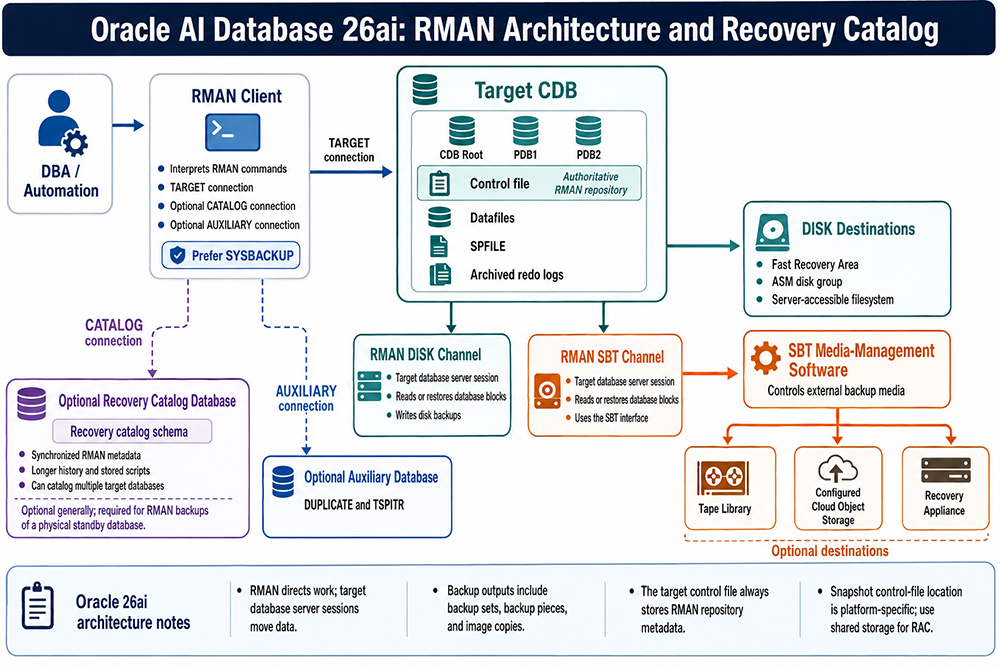
The RMAN client interprets commands and directs database work. Target-database server sessions implement the channels that read database blocks and
write or restore backups. A DISK channel accesses server-visible disk storage. An SBT channel communicates through compatible
media-management software to reach tape, configured cloud object storage, or a recovery appliance.
Backup data does not flow through the RMAN client or the recovery catalog. The diagram's direct target-to-disk line is a simplified destination
relationship; the DISK channel session performs the disk I/O. The optional auxiliary database supports operations such as duplication and
tablespace point-in-time recovery, while the optional catalog connection carries metadata.
What the recovery catalog stores
The catalog organizes metadata for each registered target database. Its records can describe:
- data-file and archived-redo-log backup sets and their backup pieces;
- data-file image copies and copies of archived redo logs;
- database structure, including tablespaces and data files;
- persistent RMAN configuration settings;
- database registrations, DBIDs, incarnations, and
DB_UNIQUE_NAMEvalues; - local and global stored RMAN scripts; and
- RMAN operation and status information available through recovery-catalog views.
The catalog does not necessarily describe every backup ever created. Its history depends on successful resynchronization, catalog availability, maintenance, upgrades, imports, deletions, and retention practices. A backup piece can exist on storage but be absent from the repository, or a repository record can refer to a file that is no longer accessible. Catalog reporting therefore complements storage monitoring, crosschecks, validation, and recovery tests.
Use catalog reports as inventory evidence
RMAN commands such as LIST, REPORT, and SHOW can summarize the metadata associated with a connected target. Catalog
views also support centralized SQL reporting. For example, RC_DATABASE identifies registered databases, RC_BACKUP_SET and
RC_BACKUP_PIECE describe backup-set inventory, RC_DATAFILE_COPY describes registered data-file copies, and
RC_RMAN_STATUS records RMAN operation status.
These reports help administrators detect missing jobs, unexpected configuration changes, obsolete inventory, or a catalog that has stopped receiving
metadata. They do not prove that a backup is physically readable, that every dependent archived log is present, or that an application will operate
after recovery. A production control should combine catalog reporting with storage monitoring, CROSSCHECK, RMAN validation, and isolated
restore-and-recovery exercises. The catalog answers important inventory questions; only a tested recovery workflow demonstrates that the inventory can
meet the recovery point and recovery time objectives.
The catalog schema and the database that hosts it are different concepts. A dedicated account owns the schema; privileged accounts such as
SYS cannot be catalog owners. The recovery catalog database is the separate Oracle database containing that schema. Its data files store
catalog metadata, while protected database backups remain in their configured destinations.
Why organizations use a recovery catalog
Repository redundancy and longer history
The catalog supplies a secondary copy of metadata that also exists in each target control file. If a target control file and its available backups are lost, catalog records can help identify surviving recovery assets. This redundancy does not replace control-file autobackups, multiplexed control files, DBID records, or a tested procedure for restoring the control file.
Some sections of the control file use circularly reusable records. CONTROL_FILE_RECORD_KEEP_TIME sets the minimum age, in days, before an
eligible reusable record can be overwritten. Its documented default is seven days. It is not a guaranteed repository-retention window because capacity
and workload also matter. Oracle warns against setting it to 0 for an RMAN-managed database because records can be reused before they reach
the catalog.
Central administration and reporting
One base recovery catalog can register multiple CDBs and other target databases. A backup team can report on configurations, backup history, incarnations, stored recovery assets, and operation status from one repository. Centralization becomes valuable when an organization manages many databases with common retention, monitoring, and audit requirements.
Stored scripts and delegated access
A catalog can store named RMAN command sequences independently of the client filesystem. A local stored script is associated with one registered target. A global stored script can be executed for any appropriate registered target. Virtual private catalog users can read global scripts, while creation or modification of global scripts remains a base-catalog responsibility.
Virtual private catalogs also support separation of duties. A base catalog owner can authorize another user to work with selected registered databases without exposing every target in the catalog. This can separate application teams, environments, or service boundaries while retaining a central base catalog.
Data Guard coordination
A recovery catalog is required when RMAN manages a Data Guard environment. The primary and physical standby databases share a DBID and database name,
but each physical database has a unique DB_UNIQUE_NAME. The catalog associates metadata and persistent configuration with the correct
physical database and coordinates backup use across the configuration.
A backup created at one database can sometimes be restored at another physical database, provided the backup is accessible from that host and meets the recovery need. The catalog records association and accessibility information, but it does not make inaccessible storage reachable. Network, media-management, encryption, and storage permissions must still support the planned recovery path.
Features that do not require a catalog
A catalog should not receive credit for capabilities supplied by RMAN itself. The following operations can use the target control-file repository:
- full, level 0, differential level 1, and cumulative level 1 backups;
- backup sets, backup pieces, image copies, and control-file autobackups;
- backup selection for restore and recovery;
- block checks during eligible backup and validation operations; and
- tablespace point-in-time recovery when the required metadata and recovery assets are available.
A recovery catalog does not generally make RMAN backup I/O faster. Its documented advantages concern metadata redundancy, centralization, extended history, stored scripts, restricted access, reporting, and Data Guard coordination. Oracle AI Database 26ai no longer supports Data Recovery Advisor commands, so they do not belong in a current catalog-benefit list.
When control-file metadata may be enough
A small environment with one database may not need a catalog when the control file retains all metadata required by the recovery window, control-file autobackups are tested, the DBID is securely recorded, and centralized reporting or stored scripts are unnecessary. The administrator should verify that reusable records cannot age out before all required catalog-independent recovery tasks are complete.
CONFIGURE CONTROLFILE AUTOBACKUP ON;
SHOW CONTROLFILE AUTOBACKUP;
A catalog adds an Oracle database or schema service, credentials, network connectivity, capacity planning, compatibility management, monitoring, and its own recovery procedure. Those responsibilities are worthwhile only when they satisfy actual recovery or governance requirements.
| Environment or requirement | Guidance |
|---|---|
| One database, short recovery window, protected control-file metadata | A control-file-only repository may be sufficient. |
| Many independently managed target databases | A centralized catalog is usually valuable. |
| History longer than control-file reuse permits | Use a catalog and ensure synchronization occurs before records age out. |
| Reusable local or global RMAN stored scripts | Use a recovery catalog. |
| Data Guard primary and physical standby databases | A recovery catalog is required. |
| Delegated access to selected registered databases | Use virtual private catalogs. |
| No tested protection plan for the catalog database | The catalog design is incomplete. |
Registration and resynchronization
A database begins using a recovery catalog after registration. Registration associates its DBID and existing repository metadata with the catalog; it
does not copy application data or backup blocks. Each ordinary registered database must have a unique DBID. Data Guard is the important exception:
its physical databases share the same DBID and use unique DB_UNIQUE_NAME values.
The following example previews the connection and registration concepts. It omits passwords from the command line so that RMAN can request credentials securely. Lesson 9 will create the owner, catalog objects, and complete the registration workflow.
rman TARGET "backup_admin@prod AS SYSBACKUP" CATALOG rco@catdb


RMAN> REGISTER DATABASE;
Resynchronization keeps catalog metadata aligned with the mounted target control file. A partial resynchronization propagates changed metadata such as new backups and archived redo logs. A full resynchronization also propagates changes to the physical database structure and persistent RMAN configuration. RMAN automatically performs the needed synchronization in most situations.
A full resynchronization creates a temporary snapshot control file so RMAN has a read-consistent view. The snapshot is not registered as a catalog backup and cannot replace a control-file autobackup. In Oracle RAC, its configured location must be accessible to the participating instances, normally through shared storage such as Oracle ASM.
Manual resynchronization is useful when the catalog was unavailable during RMAN activity, archived redo accumulates rapidly between catalog connections, standby metadata must be propagated, or records could age out before automatic synchronization:
RESYNC CATALOG;
Oracle AI Database 26ai adds two relevant improvements. Before a target-instance backup begins, RMAN automatically disconnects from the recovery catalog database and releases catalog connections that the target server sessions do not need for backup I/O. Catalog resynchronization also uses multiple savepoints. If a long synchronization encounters an unexpected failure, RMAN can roll back to an applicable savepoint instead of discarding the entire transaction.
Oracle 26ai can perform a full catalog resynchronization from a physical standby control file when the documented requirements are satisfied. Depending
on the configuration, RMAN can otherwise use the primary or report an error when the required connect information is unavailable. This is an advanced
Data Guard concern rather than a reason to run RESYNC CATALOG before every backup.
Protect and size the recovery catalog
The catalog is part of the recovery system, so it must not share the target's most important failure domains. Never create a target database's catalog inside that same target database. Avoid placing the catalog database on the same disks as the targets it protects. Separate storage, credentials, network controls, and administrative access reduce the chance that one incident destroys both production data and recovery metadata.
- Use
ARCHIVELOGmode when point-in-time recovery of the catalog database is required; Oracle recommends this configuration. - Back up the catalog database frequently, normally after the protected targets complete their backups.
- Back up the catalog database with RMAN in
NOCATALOGmode so its own control file records those backups. - Enable control-file autobackups for the catalog database and retain its DBID securely.
- Keep the required copies in independent failure domains or media according to the recovery objectives.
- Test restoration of the catalog database and the target databases without creating circular recovery dependencies.
A circular design in which database A holds the only catalog for database B and database B holds the only catalog for database A can complicate the recovery order. A shared failure may make both catalogs unavailable when they are most needed. A Data Pump export can supplement catalog protection, but a logical export does not replace physical RMAN backups of the catalog database.
Legacy fixed-size recommendations are not appropriate for 26ai. Catalog growth depends on the number of registered databases, data files, archived redo logs, backup pieces, stored scripts, operation frequency, and metadata-retention period. Oracle provides an illustrative typical estimate of about 15 MB of catalog-schema space per registered database per year, but it is a planning example rather than a capacity guarantee.
| Responsibility | Operational question |
|---|---|
| Availability | Can RMAN reach the catalog when reporting, stored scripts, or Data Guard coordination require it? |
| Currency | Are automatic resynchronizations succeeding before control-file records can be reused? |
| Protection | Can the catalog database and its control file be restored without depending on the unavailable targets? |
| Compatibility | Are catalog schema upgrades coordinated with the RMAN clients and databases that use it? |
| Capacity | Does monitoring account for metadata growth plus database, temporary, undo, redo, diagnostic, and backup space? |
| Security | Are catalog credentials and virtual private catalog grants limited to the databases each operator manages? |
The recovery catalog is valuable because it preserves and organizes metadata needed to make recovery decisions across time and across databases. It does not replace the target control file, backup media, validation, recovery testing, or a documented recovery plan. Lesson 9 builds on this role by creating a dedicated catalog owner and catalog, connecting the target, registering the database, and verifying the resulting repository.