| Lesson 5 | Managing RMAN with Enterprise Manager Cloud Control |
| Objective | Explain how Cloud Control configures, schedules, and monitors RMAN while RMAN performs backup and recovery operations. |
Managing RMAN with Enterprise Manager Cloud Control
Earlier Oracle releases included graphical products named Backup Manager. Oracle AI Database 26ai documentation instead describes Oracle Enterprise Manager Cloud Control as a browser-based management interface that provides a graphical front end and scheduling facilities for Oracle Recovery Manager (RMAN). The visible interface has changed, but the separation of responsibilities is more important than the product history.
Cloud Control helps an administrator select a monitored database target, supply authorized credentials, define a job, schedule it, and review its results. RMAN remains the Oracle-aware engine for physical backup, restore, recovery, validation, and maintenance. Target-database server sessions called channels perform the actual input and output. Cloud Control does not replace RMAN, store the physical backup pieces, or turn an unsuitable job definition into a recoverable strategy.
This lesson follows a job from its recovery requirements through graphical orchestration, RMAN execution, monitoring, and recovery assurance. The exact screens can vary with the installed Cloud Control release, database plug-in, target type, permissions, and service. The concepts remain useful even when an interface label changes.
Cloud Control and RMAN have different roles
A graphical workflow is easiest to understand when orchestration is kept separate from execution. Cloud Control stores the job definition and schedule, submits the requested work, and records job status and output. RMAN interprets the generated operation, consults the target's persistent RMAN configuration, and directs channels that access database files and backup media.
| Capability | Cloud Control contribution | RMAN responsibility |
|---|---|---|
| Target selection | Presents discovered database targets and supported scope choices. | Connects to the selected target with the required administrative privilege. |
| Configuration | Collects job parameters through supported pages and wizards. | Uses the requested commands and persistent target configuration. |
| Scheduling | Stores and launches one-time or recurring jobs. | Performs the database operation when invoked. |
| Execution | Submits RMAN work and captures its output. | Directs channels that read, write, restore, validate, or recover files. |
| Monitoring | Displays status, history, logs, alerts, and related metrics. | Reports operational results and records metadata in the RMAN repository. |
| Recovery | Guides supported restore and recovery scenarios. | Restores physical files and applies recovery for the selected operation. |
| Assurance | Centralizes evidence and follow-up. | Provides validation and restore functions; neither layer replaces a recovery drill. |
The two interfaces can request the same RMAN operation, but they are not operationally identical. Cloud Control adds its own accounts, credentials, agents, plug-ins, network paths, job states, logs, and Management Repository. Each dependency must be monitored without confusing it with the target database's RMAN repository.
Begin with recovery requirements
The operator should not begin by clicking through a wizard. The job must first be tied to an approved recovery point objective (RPO), recovery time objective (RTO), retention requirement, protected scope, and recovery priority. These decisions determine how often the job runs, what it protects, which destination it uses, and what evidence must be retained.
Before scheduling, identify the target CDB and decide whether the operation protects the whole CDB, the CDB root, selected PDBs, tablespaces, data files,
or archived redo logs. Also document whether the result will be a backup set or image copy, which DISK or SBT path will be used,
whether encryption is required, and how the result will be validated.
Cloud Control cannot determine whether a nightly schedule satisfies the business RPO or whether the selected media can meet the RTO. It automates the definition supplied by the administrator. A well-executed job can still be unsuitable if it protects the wrong scope, omits required redo, uses a shared failure domain, or cannot be restored quickly enough.
Use the current Cloud Control workflow
The Oracle AI Database 26ai Backup and Recovery User's Guide begins with the Database Home page for the monitored target. From the Availability menu, the documented path enters Backup & Recovery and then the required operation. For scheduled database backups, the guide uses the Schedule Backup page and its wizard.
The guide documents customized workflows for the CDB root and for one or more PDBs. When credentials are required, Cloud Control can use Named or New credentials. A named credential is not permission by itself. The underlying database or host account must possess the privileges required by the operation, and organizational policy must authorize its use.
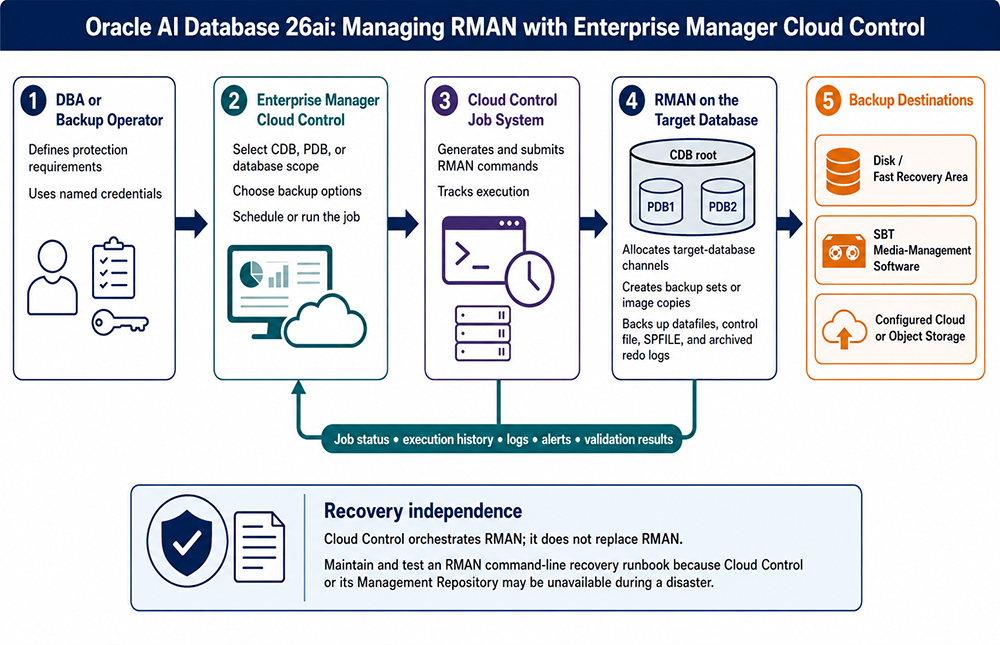
Use this sequence as a conceptual model:
Approved recovery requirements
        -> Cloud Control database target and job definition
        -> generated RMAN operation
        -> target-database channels
        -> configured DISK or SBT destination
        -> RMAN output and repository records
        -> Cloud Control job history, logs, and alerts
The installed interface may use different labels or expose additional options. Production procedures should be written and tested against the deployed Cloud Control release and database plug-in instead of relying on a static screenshot from another release.
Review the generated operation before scheduling
A graphical wizard reduces typing, but it does not remove the need to understand the RMAN operation that will run. Before activating a recurring job,
review the summary and generated RMAN content when the installed interface makes them available. Compare the result with the approved scope, current
SHOW ALL configuration, default device type, channel settings, control-file autobackup, retention policy, and archived-log deletion policy.
Pay particular attention to settings that the job inherits instead of restating. A job that does not specify a format, channel, encryption mode, or device can depend on persistent configuration stored in the target's RMAN repository. A later configuration change can therefore alter the behavior of an unchanged graphical job. Record both the job definition and the relevant configuration baseline so an operator can explain the effective operation.
Check schedule details in operational terms. Confirm the time zone, start time, repeat interval, expected duration, blackout or maintenance periods, and behavior after a missed or failed run. Prevent overlapping jobs unless concurrency has been tested. A second job can compete for channels, CPU, network, FRA space, filesystem capacity, or SBT media resources while the first job is still active.
Treat material changes to scope, destination, encryption, retention, or deletion behavior as controlled production changes. Test the revised job against nonproduction or otherwise approved resources, capture its output, and verify that monitoring recognizes both success and intentional failure. Confirm that notifications reach an owned destination and that escalation does not depend on the same infrastructure being protected.
After the first production run, reconcile the job summary with RMAN records and the destination. Verify the expected backup pieces or image copies,
control-file and SPFILE protection, archived-redo coverage, and elapsed time. Establish a measured baseline for later comparison. A sudden
change in duration, throughput, output size, or archived-log volume can reveal capacity pressure, storage degradation, workload changes, or a scope error
before the next recovery test.
Select the correct CDB or PDB scope
Oracle AI Database 26ai uses the multitenant architecture. The target and credential scope therefore affect what a scheduled operation can protect. A whole-CDB or multi-PDB operation uses the required common administrative connection to the CDB root. A supported operation connected to one PDB has a narrower scope and different restrictions.
Cloud Control can schedule a backup of the CDB root and can schedule backups for selected PDBs. A PDB-only backup does not establish complete CDB protection. Archived redo belongs to the CDB, and the recovery plan must preserve the logs required to make restored PDB data usable. The administrator should confirm the generated scope rather than infer it from a friendly job name.
A server parameter file, or SPFILE, contains persistent initialization parameter settings for an Oracle database instance. RMAN can protect
the SPFILE through database backups and control-file autobackups under the documented conditions. Password files, TDE keystores, Oracle Net
files, external data, and other non-database files require separate protection, as discussed in Lesson 4.
Understand what happens after submission
At the scheduled time, the Cloud Control job system submits the RMAN work. RMAN connects to the selected target, reads the persistent configuration in the target's RMAN repository, and allocates or uses configured channels. Each channel corresponds to a target-database server session and carries one stream of backup or restore data.
A DISK channel accesses storage visible to the database server, such as a filesystem, ASM disk group, or Fast Recovery Area. An
SBT channel calls compatible media-management software or an Oracle native library. Tape, Recovery Appliance, and supported cloud or object
storage require the applicable integration. Cloud Control does not write directly to an arbitrary object-storage location.
The target control file always contains RMAN repository information for that target. An optional recovery catalog can hold synchronized metadata and stored scripts, but it is not the Cloud Control Management Repository and it does not contain the physical backup pieces. Keeping these repositories separate prevents a graphical monitoring dependency from being mistaken for the source of RMAN backup metadata.
Interpret job states and evidence
Centralized status is one of Cloud Control's practical advantages, but a green status indicator must be interpreted in context. The job definition, RMAN output, target repository, storage system, and validation policy provide different evidence. The team should define which states generate alerts, who owns each response, and how quickly exceptions must be corrected.
| State | Meaning | Required response |
|---|---|---|
| Scheduled | A job definition exists for a future or recurring run. | Verify credentials, target availability, destination, and maintenance window. |
| Running | Cloud Control has submitted work and execution is active. | Monitor RMAN output, channel progress, storage, and database impact. |
| Succeeded | The submitted job completed without a reported fatal error. | Review output, confirm expected artifacts and scope, then apply the validation policy. |
| Failed | The job or one of its steps did not complete successfully. | Preserve evidence, identify the failed layer, correct it, and rerun as approved. |
| Warning or partial | Some requested work may have completed with exceptions. | Read the RMAN output and never treat the result as complete protection. |
Review the actual database scope, backup type, device type, destination, control-file and SPFILE protection, archived-redo coverage, channel
errors, media-manager errors, backup age, and storage capacity. A job can succeed while the destination approaches its capacity limit or while the
available backups no longer satisfy the required recovery window.
RMAN validation and restore checks provide additional evidence. They do not prove that operators can obtain credentials, reach the media, open the TDE keystore, restore every dependency, and recover the service within the RTO. Only a controlled restore-and-recovery drill exercises that complete chain.
Separate Cloud Control access from database authority
A Cloud Control user, a target-database administrator, a host account, and a media or cloud credential represent different security boundaries. Access to one does not automatically authorize the others. Assign roles and credentials according to the installed Enterprise Manager privilege model and the organization's separation-of-duties policy.
For target database work, use an account with the administrative privilege required by the RMAN operation. This course prefers a named operator granted
SYSBACKUP for routine backup administration where the deployment supports it. Do not use highly privileged accounts or broad dictionary-view
access as generic shortcuts for Cloud Control access.
Named credentials should have an identified owner, approved scope, rotation procedure, and emergency-access plan. Passwords, backup-encryption secrets, wallet credentials, and cloud keys must not appear in commands, job names, screenshots, logs, or source control. Test credential retrieval under outage conditions instead of assuming that the normal secrets service will always be available.
Keep recovery independent of Cloud Control
Cloud Control can simplify routine scheduling and guided recovery, but it must not become the only route to recovery. A site incident can make Cloud Control, its Management Repository, agents, name services, network paths, or normal credentials unavailable at the same time that the target database requires restoration.
Maintain an independently accessible RMAN command-line runbook. It should explain how authorized responders establish the Oracle software environment,
connect to the target or auxiliary database, find control-file and SPFILE autobackups, access DISK or SBT media,
obtain TDE and destination credentials, and execute the approved restore and recovery scenario. It must also define who can authorize destructive or
incomplete-recovery actions.
Test the runbook in an isolated environment without relying on the current target control file or a functioning Cloud Control deployment when the scenario assumes those components are lost. Record elapsed time, missing dependencies, manual decisions, and corrective actions. Recovery independence does not reject graphical management; it prevents the management layer from becoming a single point of operational failure.
Apply the model to Oracle RAC
RMAN remains the physical backup and recovery utility for Oracle RAC databases, and Cloud Control can manage an appropriate cluster database target. The RMAN language is shared with noncluster environments, but execution requires cluster-aware planning.
A channel runs through a target-database server session on an instance. Disk backups that may be restored through another instance must reside on storage that the restore channel can access. SBT operation depends on compatible media-management or native-library configuration on the nodes that may execute the job. Services, preferred credentials, agents, instance placement, and operational failover must match the deployed cluster design.
Additional channels do not guarantee faster backups. Parallelism must be measured against the database edition, CPU, memory, interconnect, storage, network, and external media. A schedule that works on one node should also have a documented behavior when that node or its agent is unavailable.
Cloud Control and RMAN operating checklist
| Before scheduling | Question to answer | Evidence to retain |
|---|---|---|
| Target and scope | Which CDB, root, PDBs, tablespaces, data files, or archived logs are protected? | Approved scope and generated RMAN operation. |
| Credentials | Which Cloud Control, target, host, and destination credentials are required? | Credential ownership and a successful connection test. |
| Destination | Is the path accessible, sized, monitored, and separated from production failure domains? | Capacity evidence and a test backup and restore. |
| Schedule | Does the frequency satisfy the RPO without exceeding the backup window? | Job schedule and measured duration. |
| Retention | Are RMAN retention and archived-log deletion policies coordinated? | Configuration review and repository report. |
| Security | Are encryption material and recovery credentials protected and recoverable? | Approved keystore and credential procedures. |
| Monitoring | Who receives job failures, warnings, capacity alerts, and stale-backup alerts? | Notification ownership and escalation record. |
| Recovery | Can the operation be completed when Cloud Control is unavailable? | Tested RMAN command-line runbook and recovery-drill result. |
Cloud Control is valuable when it makes RMAN operations visible, repeatable, and accountable. Its value depends on a sound recovery design, accurate job parameters, secure credentials, accessible destinations, useful alerts, and disciplined follow-up. The final measure is not whether a wizard completed; it is whether the required database service can be restored within its approved objectives.
The next lesson examines backup sets, the RMAN format used by many scheduled backup jobs. The graphical interface does not change backup-set semantics; it provides another way to define, submit, and monitor the RMAN operation.