| Lesson 4 | Multiplexing and backup sets |
| Objective | Discuss how and why Recovery Manager multiplexes backup sets |
Oracle RMAN Backup Multiplexing and FILESPERSET
Oracle Recovery Manager (RMAN) controls how database files are read and how their blocks are written into backup sets. During a backup, one RMAN channel can read blocks from several input files concurrently and interleave those blocks in the same backup piece. Oracle calls this process backup multiplexing.
Multiplexing can combine the read rates of several input files into one output stream. This can help keep a fast backup destination supplied with data when no individual input file can provide blocks quickly enough. The behavior is controlled primarily by the
Before examining those settings, it is important to distinguish a backup set from a backup piece. These terms describe related parts of an RMAN backup, but they are not interchangeable.
Multiplexing can combine the read rates of several input files into one output stream. This can help keep a fast backup destination supplied with data when no individual input file can provide blocks quickly enough. The behavior is controlled primarily by the
FILESPERSET option of the BACKUP command and the MAXOPENFILES setting of the RMAN channel.
Before examining those settings, it is important to distinguish a backup set from a backup piece. These terms describe related parts of an RMAN backup, but they are not interchangeable.
Backup sets and backup pieces
A backup set is a logical RMAN backup unit recorded in the RMAN repository. It contains backup data from one or more datafiles,
control files, server parameter files, or archived redo logs.
A backup piece is a physical file or media-manager object that belongs to a backup set. A backup set contains one or more backup pieces. RMAN creates and manages the pieces, so they should not be treated as independent operating-system backups.
One
Consequently, it is incorrect to assume that each backup specification always creates one backup file. A backup specification can result in one or more backup sets, and a backup set can consist of more than one backup piece.
A backup piece is a physical file or media-manager object that belongs to a backup set. A backup set contains one or more backup pieces. RMAN creates and manages the pieces, so they should not be treated as independent operating-system backups.
One
BACKUP command can create multiple backup sets. Each backup set can then contain one or more pieces. The resulting number of sets and pieces can be affected by the input files, channel allocation, FILESPERSET, MAXPIECESIZE, media-manager restrictions, and the amount of backup data.
Consequently, it is incorrect to assume that each backup specification always creates one backup file. A backup specification can result in one or more backup sets, and a backup set can consist of more than one backup piece.
How RMAN multiplexes input files
When RMAN multiplexes a backup, one channel reads blocks from multiple input files and writes those blocks into the same backup piece. Blocks from
the input files can therefore be interleaved in the output.
For example, suppose a channel is backing up three datafiles. Rather than reading the first datafile completely before moving to the second one, the channel can obtain blocks from each datafile as input becomes available. The resulting backup piece can contain blocks from all three files. RMAN records the information required to identify and restore every block.
Multiplexing applies to backup sets. It does not apply to image copies. An image copy reproduces one datafile, control file, or archived redo log as a separate file and is never multiplexed with another input file.
Oracle AI Engineering
For example, suppose a channel is backing up three datafiles. Rather than reading the first datafile completely before moving to the second one, the channel can obtain blocks from each datafile as input becomes available. The resulting backup piece can contain blocks from all three files. RMAN records the information required to identify and restore every block.
Multiplexing applies to backup sets. It does not apply to image copies. An image copy reproduces one datafile, control file, or archived redo log as a separate file and is never multiplexed with another input file.
Why RMAN uses multiplexing
Multiplexing was particularly useful for maintaining a steady stream of data to sequential tape devices. If one source file could not provide data fast enough, a channel could alternate among several files and combine their read rates.
The same general principle can apply to modern disk and media-management destinations. A channel reading files from different source devices may produce a steadier output stream than a channel that depends on the read rate of only one file.
Multiplexing does not automatically improve every backup. Its effectiveness depends on the source storage, backup destination, channel configuration, compression, encryption, and workload. Cloud and object-storage destinations should not be assumed to behave like sequential tape devices. The complete backup and restore path must be measured under representative conditions.
Higher multiplexing levels can also affect restore performance. When blocks from several input files are distributed throughout a backup piece, RMAN may need to process more of that piece while reconstructing an individual datafile. Administrators should balance backup throughput against restore requirements rather than simply selecting the largest possible multiplexing level.
The same general principle can apply to modern disk and media-management destinations. A channel reading files from different source devices may produce a steadier output stream than a channel that depends on the read rate of only one file.
Multiplexing does not automatically improve every backup. Its effectiveness depends on the source storage, backup destination, channel configuration, compression, encryption, and workload. Cloud and object-storage destinations should not be assumed to behave like sequential tape devices. The complete backup and restore path must be measured under representative conditions.
Higher multiplexing levels can also affect restore performance. When blocks from several input files are distributed throughout a backup piece, RMAN may need to process more of that piece while reconstructing an individual datafile. Administrators should balance backup throughput against restore requirements rather than simply selecting the largest possible multiplexing level.
Controlling backup sets with FILESPERSET
The
In Oracle AI Database 26ai, the default value of
FILESPERSET option specifies the maximum number of input files that RMAN may place in one backup set. It does not specify the number of physical backup pieces in the set.
In Oracle AI Database 26ai, the default value of
FILESPERSET is 64. The number of input files assigned to a backup set is determined by the smaller of the following values:
- The value of
FILESPERSET. - The number of files assigned to and read by the channel.
Files per backup set =
min(FILESPERSET, files read by each channel)FILESPERSET option can apply to an entire BACKUP command or to an individual backup specification within the
command. Its placement should reflect the part of the backup policy that it is intended to control.
Using the default FILESPERSET value
Consider a backup of three datafiles:
This is a possible result, not a guarantee that every three-file backup will always produce exactly one physical piece. Channel allocation, piece-size limits, media-manager behavior, and other RMAN settings can influence the final output.
BACKUP DATAFILE 1, 2, 3;FILESPERSET value is greater than the number of input files, all three datafiles may be assigned to one backup
set. If one channel reads these files concurrently, blocks from the three datafiles can be multiplexed into that set's backup piece.
This is a possible result, not a guarantee that every three-file backup will always produce exactly one physical piece. Channel allocation, piece-size limits, media-manager behavior, and other RMAN settings can influence the final output.
Preventing cross-file multiplexing
To place no more than one input datafile in each backup set, specify
This setting can provide more granular backup sets and simpler isolation of an input file. It can also increase the number of backup sets and pieces that RMAN must create, retain, catalog, and manage.
FILESPERSET 1:
BACKUP FILESPERSET 1 DATAFILE 1, 2, 3;This setting can provide more granular backup sets and simpler isolation of an input file. It can also increase the number of backup sets and pieces that RMAN must create, retain, catalog, and manage.
Allowing two input files per backup set
The following command permits RMAN to place as many as two input datafiles in each backup set:
The exact pairing of datafiles is not guaranteed. It can depend on the available channels, the input list, the workload, and RMAN's assignment of backup work. A diagram showing datafile 1 paired with datafile 3 illustrates one possible grouping rather than a required grouping.
BACKUP FILESPERSET 2 DATAFILE 1, 2, 3;The exact pairing of datafiles is not guaranteed. It can depend on the available channels, the input list, the workload, and RMAN's assignment of backup work. A diagram showing datafile 1 paired with datafile 3 illustrates one possible grouping rather than a required grouping.
Controlling concurrent reads with MAXOPENFILES
The
The effective multiplexing level is the smaller of the number of files in the backup set and the channel's
MAXOPENFILES setting belongs to an RMAN channel. It limits the number of input files that one channel can have open concurrently. The default value in Oracle AI Database 26ai is 8.
The effective multiplexing level is the smaller of the number of files in the backup set and the channel's
MAXOPENFILES value:
Multiplexing level =
min(MAXOPENFILES, files in the backup set)RUN block permits as many as eight files in a backup set but limits the channel to four concurrently open
input files:
RUN {
  ALLOCATE CHANNEL c1
    DEVICE TYPE DISK
    MAXOPENFILES 4;

  BACKUP FILESPERSET 8 DATABASE;
}c1 can read no more than four of those files concurrently.
The possible multiplexing level for that channel is therefore limited to four.
Comparing FILESPERSET and MAXOPENFILES
| Setting | Scope | What it limits | Oracle 26ai default |
|---|---|---|---|
FILESPERSET |
BACKUP command or backup specification |
Input files assigned to each backup set | 64 |
MAXOPENFILES |
RMAN channel | Input files one channel reads concurrently | 8 |
FILESPERSET controls backup-set membership. MAXOPENFILES controls concurrent input reads. RMAN considers both values
when determining the possible multiplexing level.
Multiplexing and FILESPERSET
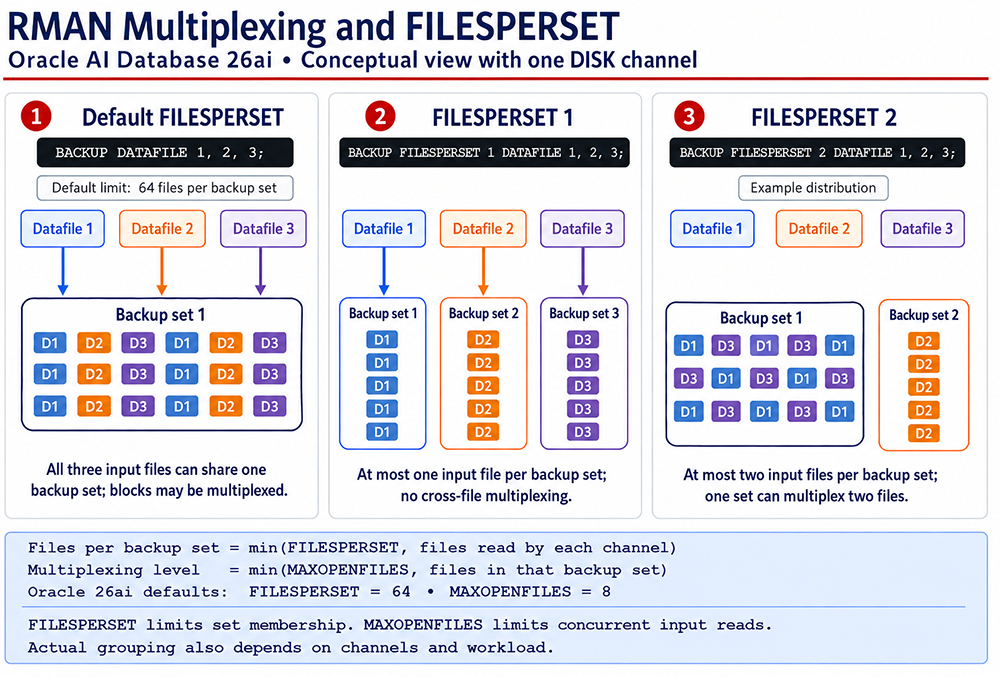
The first panel illustrates a possible result when the default
FILESPERSET value permits three datafiles to belong to one backup set.
The second panel shows how FILESPERSET 1 prevents cross-file multiplexing by limiting each set to one input datafile. The third panel
shows one possible grouping when FILESPERSET 2 permits two input datafiles in a set.
Multiplexing and channel parallelism
Multiplexing and parallelism are related performance techniques, but they describe different behavior:
Increasing the number of channels can reduce the number of files assigned to each channel. This can indirectly change the effective multiplexing level even when the
- Multiplexing occurs when one channel interleaves blocks from multiple input files in a backup piece.
- Parallelism occurs when multiple channels create separate backup sets or file sections at the same time.
Increasing the number of channels can reduce the number of files assigned to each channel. This can indirectly change the effective multiplexing level even when the
FILESPERSET value remains unchanged.
Backup operations that are not multiplexed
Some RMAN operations deliberately keep their input separate:
- Image copies: Each image copy corresponds to one input file. An image copy is not multiplexed with another datafile, control file, or archived redo log.
- Multisection backups: RMAN can divide one large datafile into sections so that multiple channels can back it up in parallel. A section is not multiplexed with another section or with a different datafile.
Choosing practical multiplexing settings
Keep the default settings unless testing identifies a reason to change them. Multiplexing should be tuned as part of the complete backup system,
not as an isolated RMAN feature.
Consider using
The following factors can influence the result:
Consider using
FILESPERSET 1 when separate backup sets for individual input files provide a meaningful operational benefit, such as
avoiding cross-file multiplexing or improving failure isolation. Consider larger values when aggregated input throughput improves backup
performance and restore tests remain within the required recovery window.
The following factors can influence the result:
- The number and type of allocated RMAN channels.
- The source-storage devices and their available read bandwidth.
- The performance characteristics of the backup destination.
- The use of backup compression and encryption.
- Media-manager configuration and device limits.
- Backup-piece size, retention, and catalog-management requirements.
- The recovery-time objectives for complete and individual-file restores.
FILESPERSET or MAXOPENFILES, test both backup and restore performance. Useful measurements include backup
elapsed time, sustained throughput, source-storage latency, destination utilization, restore elapsed time, and the number and size of the backup
pieces produced.
Lesson summary
RMAN multiplexing allows one channel to interleave blocks from multiple input files in a backup piece.
Backup sets are logical RMAN units, and backup pieces are their physical output files or media-manager objects. A backup set can contain multiple pieces, so the two terms should not be used interchangeably.
Multiplexing can improve backup throughput by combining input streams, but excessive multiplexing can make some restore operations less efficient. Select settings by measuring both backup and restore behavior against the database's recovery requirements.
FILESPERSET limits how many
input files may belong to each backup set, while MAXOPENFILES limits how many input files a channel can read concurrently.
Backup sets are logical RMAN units, and backup pieces are their physical output files or media-manager objects. A backup set can contain multiple pieces, so the two terms should not be used interchangeably.
Multiplexing can improve backup throughput by combining input streams, but excessive multiplexing can make some restore operations less efficient. Select settings by measuring both backup and restore behavior against the database's recovery requirements.
In the next lesson, you will learn how RMAN uses multiple channels and multisection backups to create backups in parallel.
Backup Sets Properties - Quiz
Test your understanding of backup sets, backup pieces, multiplexing,
Backup Sets Properties - Quiz
FILESPERSET, and MAXOPENFILES.
Backup Sets Properties - Quiz