| Lesson 13 | Same TWO_TASK Mechanism — Different Era |
| Objective | Describe the evolution of Oracle Net Services from SQL*Net to Oracle 23ai |
Oracle Net Services — Evolution from SQL*Net to Oracle 23ai
Oracle Net Services is the successor to SQL*Net — the original Oracle networking protocol that provided the first practical mechanism for client applications and remote servers to communicate with Oracle databases over networks. The evolution from SQL*Net version 1 through Net8, Oracle Net, and into Oracle Net Services in Oracle 23ai spans more than three decades of continuous refinement. The core mechanism — Oracle Net providing a transparent, protocol-independent communication layer above the physical network — has remained consistent throughout. What has changed is the security model, the configuration approach, the authentication options, and the degree of integration with Oracle's high-availability and cloud infrastructure ecosystem.
The TWO_TASK environment variable is a useful lens for understanding this evolution. Introduced in
SQL*Net version 1 as the primary mechanism for specifying a remote database connection, it still exists in Oracle
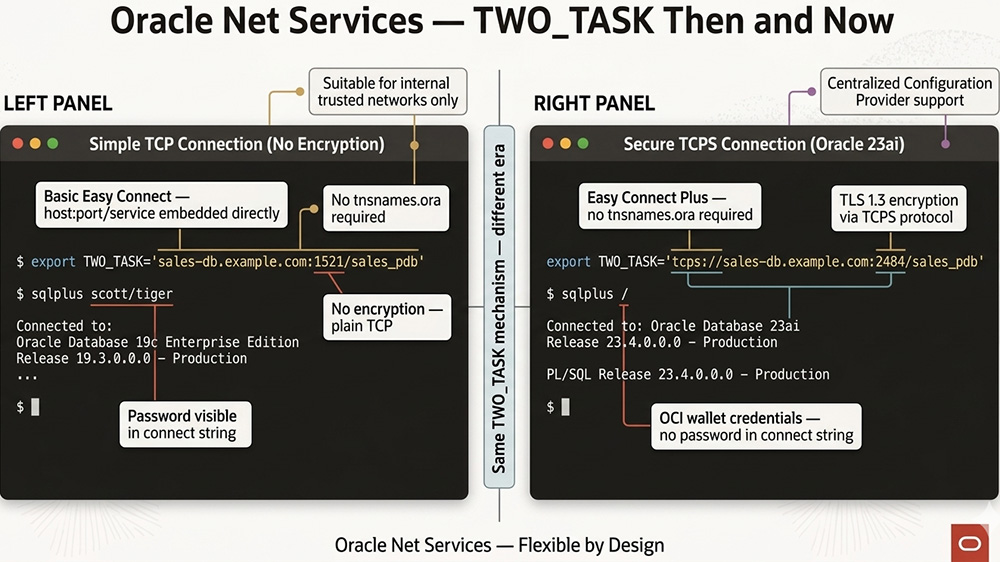
23ai — but what you assign to it has changed fundamentally. The diagram below illustrates both
ends of that 35-year journey on the same screen.
SQL*Net Version 1 — The Starting Point
SQL*Net version 1 was Oracle's first attempt at database connectivity across a network. It was a proprietary
networking solution with no competing Oracle-native alternative — if you wanted to connect a client application
to a remote Oracle database, SQL*Net was the only path. The architecture was minimal by modern standards: every
connection request had to embed the full connection information — the protocol, the hostname or IP address, and
the database name — directly in the connection string or in the TWO_TASK environment variable.
On UNIX, the TWO_TASK variable specified the default remote database for SQL*Plus and Oracle tools.
Setting it to t:dilbert:tom told SQL*Net to use TCP/IP (t), connect to a server named
dilbert, and open the database named tom. Every element of the connection was explicit
and embedded — there was no service name alias, no tnsnames.ora lookup file, and no separation between the
connection identifier and the connection details.
The primary shortcoming of SQL*Net version 1 was this requirement to know all connection information at the point of connection. When server hostnames changed or databases moved to different machines, every application and script that embedded connection details required manual updating. SQL*Net version 2 addressed this by introducing the tnsnames.ora lookup file — separating the short alias that applications used from the full connection descriptor that Oracle Net resolved behind the scenes.
The Evolution — SQL*Net to Oracle Net Services
Oracle's networking layer carried different names across major releases, each reflecting the Oracle version it shipped with and the capabilities it introduced:
| Release | Network Layer Name | Key Advancement |
| Oracle 6 / Oracle 7 | SQL*Net v1 | First Oracle network connectivity; TWO_TASK variable; full connection details embedded in every request; protocol prefixes (t: for TCP/IP) required explicitly |
| Oracle 7.x / Oracle 8 | SQL*Net v2 / Net8 | tnsnames.ora lookup file introduced; SERVICE_NAME replacing SID; multi-protocol community support; lsnrctl listener management replacing ORASRV/tcpctl |
| Oracle 9i | Oracle Net / Oracle Net Services | Unified product name; Oracle Net Manager for centralized configuration; service naming standardized; connection load balancing and Oracle Connection Manager (CMAN) introduced |
| Oracle 10g / 11g R2 | Oracle Net Services | Easy Connect naming introduced (no tnsnames.ora for simple connections); RAC integration with Fast Application Notification (FAN); Advanced Security Option for SSL/TLS; IPv6 support; DRCP |
| Oracle 19c | Oracle Net Services | Easy Connect Plus extended syntax; larger default SDU; improved diagnostics; long-term support release forming the stable base for 21c and 23ai features |
| Oracle 23ai | Oracle Net Services | TLS 1.3 default for TCPS; OCI IAM token authentication; Centralized Configuration Providers (OCI Object Storage JSON); system wallets for one-way TLS; TCP Fast Open; 64 KB default SDU |
TWO_TASK in Oracle 23ai — Same Mechanism, Different Era
The left panel of the diagram shows a simple TCP connection using TWO_TASK with the
basic Easy Connect syntax — host, port, and service name embedded directly in the variable value, connecting
to Oracle Database 19c with a visible password in the connect string and no encryption on the wire. This is a
valid connection pattern for trusted internal networks where TLS overhead is deliberately avoided.
-- Simple TCP connection using TWO_TASK (internal trusted network)
export TWO_TASK='sales-db.example.com:1521/sales_pdb'
sqlplus scott/tiger
The right panel shows the same TWO_TASK mechanism carrying a fully modern Oracle 23ai connection
— Easy Connect Plus with TCPS protocol, TLS 1.3 encryption, OCI wallet credentials, and no password in the
connect string. The application syntax is identical: sqlplus /. The network security posture is
completely different.
-- Secure TCPS connection using TWO_TASK (Oracle 23ai production)
export TWO_TASK='tcps://sales-db.example.com:2484/sales_pdb'
sqlplus /
Connected to: Oracle Database 23ai Release 23.4.0.0.0 - Production
PL/SQL Release 23.4.0.0.0 - Production
The center divider label captures the lesson precisely: "Same TWO_TASK mechanism — different era." Oracle Net Services preserved backward compatibility through every generation while layering modern security and cloud capabilities on top of the original architecture.
What Makes Oracle Net Services Distinctive in Oracle 23ai
Oracle Net Services is no longer unique in the absolute sense that SQL*Net was before Oracle 8 — competing databases have developed their own mature networking layers, and industry standards like TCP/IP and TLS have commoditized basic client-server connectivity. What makes Oracle Net Services distinctive in 2026 is not the networking mechanism itself but its depth of integration with the Oracle database ecosystem:
- RAC and Active Data Guard integration: Oracle Net Services provides native client-side connection load balancing, connect-time failover, Fast Application Notification (FAN), and Fast Connection Failover (FCF) that are tightly coupled with Oracle RAC and Active Data Guard. Applications transparently reconnect to surviving nodes after a failure — no application code changes required. This level of zero-application-change high availability remains more seamless in Oracle Net than in equivalent solutions for other database platforms.
- Easy Connect Plus flexibility: The same connection string mechanism that supported basic TWO_TASK connections in SQL*Net v1 now supports inline TLS parameters, wallet references, connection timeouts, retry counts, and Centralized Configuration Provider URLs — all without requiring a tnsnames.ora file. Oracle Net Services is flexible by design: simple connections remain simple, and complex enterprise configurations are achievable without sacrificing simplicity at the application layer.
- Converged database support: Oracle Net works uniformly across Oracle's converged database capabilities — relational, JSON, XML, spatial, graph, and the VECTOR data type introduced in Oracle 23ai — without requiring separate networking stacks for different workload types. A single Oracle Net connection supports all data models simultaneously.
- Security depth: TLS 1.3 as the default for TCPS connections, OCI IAM token authentication eliminating passwords from connect strings, system wallets simplifying one-way TLS, and native network encryption through sqlnet.ora — all centrally managed through the same Oracle Net configuration layer that has existed since Oracle 9i.
- OCI cloud-native integration: Centralized Configuration Providers in Oracle 23ai store connection descriptors as JSON in OCI Object Storage — eliminating the tnsnames.ora distribution problem that challenged Oracle DBAs for decades. The same Easy Connect Plus syntax that works on-premises works in OCI without modification, and OCI's private backbone network provides the low-latency transport that makes synchronous Active Data Guard replication across regions practical.
Oracle Net Services — Once Proprietary, Now Best-in-Class
The Grok 4 analysis of Oracle Net Services uniqueness reached a precise conclusion: before Oracle 8, SQL*Net was the only practical Oracle connectivity mechanism — unique by necessity. In Oracle 11g R2, Oracle Net Services was notably stronger than competing database networking layers for Oracle-centric high-availability scenarios. In Oracle 19c and 23ai, it is best described as mature, highly optimized for Oracle workloads, and feature-rich — competing in a standardized networking world where its real differentiator is integration depth with the Oracle stack rather than networking technology exclusivity.
For any environment where Oracle RAC, Active Data Guard, Oracle Sharding, Application Continuity, or Transaction Guard are in use, Oracle Net Services remains the most seamless path to zero-application-change high availability. For simpler deployments, it delivers the same simplicity that the original TWO_TASK mechanism provided — with modern security defaults replacing the plaintext, unencrypted connections of the SQL*Net v1 era. The next lesson examines the specific enhancements built into SQL*Net version 2 that established the tnsnames.ora architecture still in use today.