| Lesson 4 | Working with input masks |
| Objective | Use the Input Mask Wizard to specify data input formats in Access 365 |
Working with Input Masks
An input mask is a field-level pattern that guides (and optionally enforces) how data is typed into a table field or a bound control on a form. Instead of letting users enter “anything,” an input mask prompts for the exact shape of the value you want—such as digits-only phone numbers, ZIP codes, or Social Security numbers.
Input masks are primarily a data entry consistency tool. They reduce typos, improve uniformity, and make the user
experience smoother by showing placeholders (for example, (___) ___-____) while the user types.
Common use cases
Input masks work best when the value has a predictable structure:
- Phone numbers
- Postal/ZIP codes
- State or province abbreviations
- Dates entered in a strict format (when you must use text storage)
- National identifiers (for example, SSNs) when policy permits collecting them
Input masks vs data validation
An important detail: an input mask does not guarantee that the value is “real”—it only constrains the shape
of the data. For example, a mask can require 999-99-9999, but it cannot tell whether that number is legitimate.
For business correctness, pair input masks with:
- Validation Rule (field property) to enforce allowable ranges or patterns
- Validation Text to provide a friendly message when rules fail
- Required, Allow Zero Length, and Indexed where appropriate
- Optionally, unique indexes (or primary keys) to prevent duplicates
Why the Input Mask Wizard matters
You can type mask expressions manually, but it’s easy to make mistakes. The Input Mask Wizard is the safer and faster approach because it:
- Provides a library of common masks (phone, ZIP, SSN, etc.)
- Lets you preview how entry will look for users
- Helps you decide whether literal characters should be stored with the data
Launching the Input Mask Wizard
You launch the wizard from Table Design view (or from the Property Sheet for a bound form control) by clicking the Builder button next to the Input Mask property.

Example: applying a Social Security number mask
The slideshow below demonstrates the typical workflow: create a field, open the wizard, select a mask, and then test entry. The example uses an SSN-style mask to illustrate mechanics.
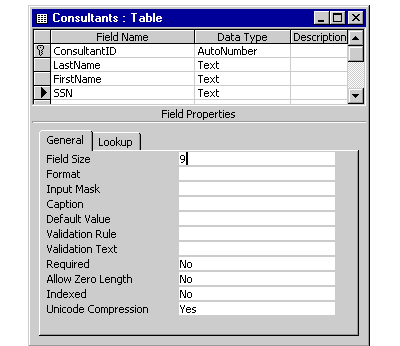
SSN) to the table in Design view.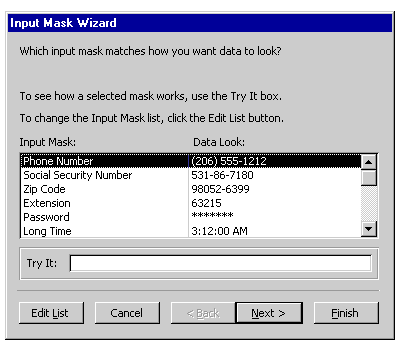
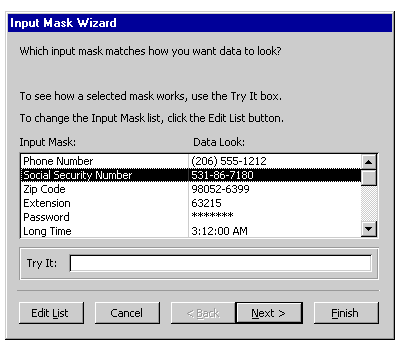
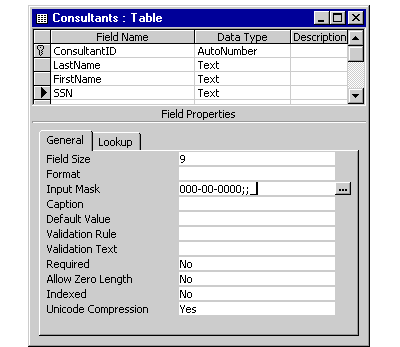
How Access stores an input mask
In Access, an input mask is commonly described as having three parts separated by semicolons:
-
Mask pattern (required) — the placeholder characters and any literal formatting characters (such as
(,),-,.). -
Store literals (optional) — determines whether literal characters are stored in the field along with the typed data.
0= store literal characters (formatting becomes part of the stored value)1= do not store literals (formatting is only displayed)
- Placeholder character (optional) — the character shown for unfilled positions (underscore is common).
Example structure:
(999) 000-0000;0;_
In that example, the parentheses and hyphen are literals, the “store literals” choice is 0 (store them), and
the placeholder is _.
Mask characters you’ll see often
You don’t need to memorize every symbol to use masks effectively, but a few show up constantly:
0— required digit (0–9)9— optional digit (0–9)L— required letter (A–Z)?— optional letterA— required letter or digita— optional letter or digit&— required any characterC— optional any character
This is why the wizard is valuable: it supplies good defaults and prevents subtle formatting mistakes.
Where to apply input masks
Input masks can be applied in multiple places, but you should decide based on your design goal:
- Table field: best when you want consistent entry no matter how the field is edited (tables, forms, datasheets).
- Form control: best when the rule is UI-specific (for example, one form needs strict entry; another is used by admins).
- Query output: sometimes used to format display, but it’s not a substitute for correct data typing and validation.
Design tips and pitfalls
- Prefer the correct data type first. For dates and numbers, use Date/Time and Number types instead of storing them as text. Input masks are most useful for text fields that represent structured identifiers.
- Be careful with “Store literals.” If you store formatting characters, searching and comparisons may behave differently (for example, some values include dashes and some don’t).
- Don’t confuse masks with security. If you store sensitive identifiers, protect the database and consider data minimization (only collect what you truly need).
- Combine with Validation Rule when needed. Masks enforce shape; Validation Rules enforce meaning.
Next step
In the next lesson, you will learn how to set up fields and controls that use Combo Boxes and List Boxes to standardize data input even further.
Input Masks - Exercise
Input Masks - Exercise